RING SIZING

SIZING GUIDANCE

UK Ring Size Guide

UK letters on this page belong to the chart below. They are not an inner circumference in millimetres. Measure a round ring, then read the letter on that same row. Another chart, including GIA, can pair the same letter with a different opening.

Finger size changes with temperature, time of day and band width. A narrow band and a wide band on the same finger can feel different at the same letter.

The chart is this page's UK reference. Each row keeps an inside diameter, a listed circumference, a UK letter and the other labels beside them. Send the millimetres and the name of the chart. GIA's chart does not always use the same letter for the same opening.

À Vie is a bespoke ring studio working with clients across the UK from Manchester. Before a ring is made we need a finger measurement and the band width you want. Measuring at home has limits.

For a full UK, US, EU and millimetre chart with one row per size, see our UK ring size conversion chart.

Full ring size conversion chart

Read the inside measurement in millimetres, then use every label on that same row. UK letters on this chart are not circumference values. ISO 8653 defines circumference with a ring stick. GIA can pair the same letter with a different opening, so keep the millimetres and the chart name together.

On this chart, 17.3 mm inside diameter is listed as 54.4 mm circumference, UK N½ and US 7. Diameter times π (3.1416) is about 54.3 mm, which is the circumference GIA lists for US 7 and UK N. Here, 17.4 mm is UK O and US 7.25, and 17.7 mm is UK O½ and US 7.5. GIA pairs 17.7 mm and 55.6 mm with UK O and US 7½. 54.7 mm is the UK O row at 17.4 mm. 54 mm is not a row: the nearest listed circumferences are 53.8 mm (UK N) and 54.1 mm (UK N½).

Show alongside UK:
International ring size conversion chart showing UK, EU/ISO, US/Canada, Asia, Italy/Spain and German ring sizes, with inner circumference and diameter in millimetres.
Circum.mm Diametermm EU / ISOFrance / Europe US / CAUSA & Canada UK / AUUnited Kingdom Italy / SpainEU size - 40 AsiaJP / CN / SG / HK Germandiameter mm
44.0 14.0 44 2.75 F 4 4 14
44.3 14.1 44 3 F½ 4 4 14
44.6 14.2 45 3.25 G 5 14
44.9 14.3 45 3.25 G 5 5 14
45.2 14.4 45 3.5 G½ 5 5 14
45.6 14.5 46 3.5 G½ 6 15
46.2 14.7 46 3.75 H 6 6 15
46.5 14.8 47 4 H½ 7 15
46.8 14.9 47 4 H½ 7 7 15
47.1 15.0 47 4.25 I 7 15
47.4 15.1 47 4.25 I 7 8 15
47.8 15.2 48 4.5 I½ 8 8 15
48.0 15.3 48 4.5 I½ 8 15
48.4 15.4 48 4.75 J 8 9 15
48.7 15.5 49 4.75 J 9 9 16
49.0 15.6 49 5 J½ 9 16
49.3 15.7 49 5 J½ 9 16
49.6 15.8 50 5.25 K 10 10 16
50.0 15.9 50 5.25 K 10 10 16
50.3 16.0 50 5.5 K½ 10 16
50.6 16.1 51 5.5 K½ 11 16
51.0 16.2 51 5.75 L 11 16
51.2 16.3 51 5.75 L 11 11 16
51.5 16.4 52 6 L½ 12 11 16
51.8 16.5 52 6 L½ 12 17
52.2 16.6 52 6.25 M 12 17
52.5 16.7 53 6.25 M 13 12 17
52.8 16.8 53 6.5 M½ 13 12 17
53.1 16.9 53 6.5 M½ 13 17
53.4 17.0 53 6.75 N 13 17
53.8 17.1 54 6.75 N 14 13 17
54.1 17.2 54 7 N½ 14 13 17
54.4 17.3 54 7 N½ 14 17
54.7 17.4 55 7.25 O 15 17
55.0 17.5 55 7.25 O 15 18
55.3 17.6 55 7.5 O½ 15 14 18
55.6 17.7 56 7.5 O½ 16 14 18
55.9 17.8 56 7.75 P 16 18
56.2 17.9 56 7.75 P 16 18
56.6 18.0 57 8 P½ 17 15 18
56.9 18.1 57 8 P½ 17 15 18
57.2 18.2 57 8.25 Q 17 18
57.5 18.3 58 8.25 Q 18 18
57.8 18.4 58 8.5 Q½ 18 15 18
58.1 18.5 58 8.5 Q½ 18 18
58.4 18.6 58 8.75 R 18 16 18
58.8 18.7 59 8.75 R 19 16 19
59.1 18.8 59 9 R½ 19 19
59.4 18.9 59 9 R½ 19 19
59.7 19.0 60 9 R½ 20 17 19
60.0 19.1 60 9.25 S 20 17 19
60.3 19.2 60 9.25 S 20 19
60.6 19.3 61 9.5 S½ 21 19
60.9 19.4 61 9.5 S½ 21 18 19
61.3 19.5 61 9.75 T 21 18 19
61.6 19.6 62 9.75 T 22 20
61.9 19.7 62 10 T½ 22 20
62.2 19.8 62 10 T½ 22 19 20
62.5 19.9 63 10.25 U 23 20
62.8 20.0 63 10.25 U 23 20
63.2 20.1 63 10.5 U½ 23 19 20
63.5 20.2 64 10.5 U½ 24 20 20
63.8 20.3 64 10.75 V 24 20
64.1 20.4 64 10.75 V½ 24 20
64.4 20.5 64 11 V½ 24 21 20
64.7 20.6 65 11 W 25 20
65.1 20.7 65 11.25 W 25 21
65.4 20.8 65 11.25 W½ 25 22 21
65.7 20.9 66 11.5 W½ 26 22 21
66.0 21.0 66 11.5 X 26 21
66.3 21.1 66 11.75 X 26 21
66.6 21.2 67 11.75 X½ 27 23 21
66.9 21.3 67 12 X½ 27 21
67.2 21.4 67 12 Y 27 21
67.5 21.5 68 12.25 Y 28 24 21
67.9 21.6 68 12.25 Y½ 28 22
68.2 21.7 68 12.5 Z 28 22
68.5 21.8 69 12.5 Z 29 25 22
68.8 21.9 69 12.75 Z½ 29 22
69.1 22.0 69 12.75 Z+1 29 22
69.4 22.1 69 13 Z+1 29 26 22
69.7 22.2 70 13 Z+1½ 30 26 22
70.1 22.3 70 13.25 Z+2 30 22
70.4 22.4 70 13.25 Z+2 30 22
70.7 22.5 71 13.5 Z+2½ 31 27 23
71.0 22.6 71 13.5 Z+3 31 23

EU / ISO and French sizing: the EU/ISO size is the inner circumference of the ring in millimetres, rounded to the nearest whole number.

Italy / Spain sizing: this column uses the common Italy and Spain conversion of EU/ISO size minus 40. For example, EU 54 converts to Italy / Spain size 14.

German sizing: this column is a rounded diameter reference. Use the exact diameter column for the most precise measurement.

Not sure which row applies? Send the measurement in millimetres, the chart or gauge you used, and the band width. We will sense-check it before anything is made.

Book a consultation

PLANNING A SURPRISE

How to find a ring size without asking

  • Borrow a round ring they wear on the same finger. Measure the inner diameter in millimetres and match that number to this chart. Put the ring back.
  • Ask someone who knows the gauge. A letter is useful only with the chart or gauge it came from.
  • Do not press the ring into soap or modelling clay. An impression of the outside, or a distorted inside edge, is not an inside diameter.
  • Do not pick a larger letter to be safe. Send the measurement you have, and the band width. We will say whether that design can be adjusted later.
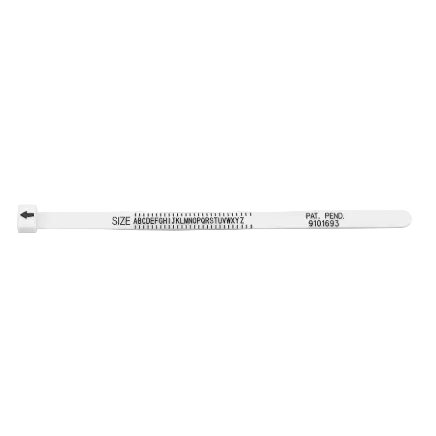
Ring sizing

Choosing the right size

A well fitted ring should slide on with slight resistance and sit securely at the base of the finger without pinching. Comfort matters, but so does security, especially for engagement rings worn every day.

À Vie Diamonds tip

If the ring must pass a larger knuckle, it still has to sit securely at the base of the finger. A finger gauge close to the width of the finished band shows that more clearly than string. We do not post a sizing gauge with an enquiry.

Before you measure

  • Pick the correct finger

    Left and right hands can differ, especially if you are right handed.

  • Measure when your hands are warm

    Cold hands measure smaller. Heat and swelling can measure larger.

  • Measure more than once

    Ideally later in the day when size is more stable.

  • Consider band width

    A wider band has more contact with the finger. Match the gauge width to the finished band. There is no fixed amount to add.

  • Use a round ring

    An inside-diameter chart applies only when the ring you measure is round.

How to measure

Three ways to find your size

Method 1

Measure a ring you already own

If you have a ring that fits the same finger, it must be round. Measure the inner diameter in millimetres across the opening. On a mandrel, read the size at the centre of the band width, and do not force the ring onto the stick.

Match that diameter to the row on this page's chart and keep the letter printed there. Callipers are steadier than a ruler.

Use a round ring

Method 2

Thread or paper strip

Wrap a non-stretch strip around the finger where the ring will sit, mark the overlap, and measure that length in millimetres. That length estimates circumference. It is not a UK letter. ISO 8653 defines ring-size circumference on a specified ring stick, not by turning a letter into millimetres.

String and paper change tension, so treat this as a rough check. The circumference in millimetres guide shows how a diameter becomes a circumference.

Approximate estimate

Method 3

Sizing kit

A finger gauge is useful when its width is close to the finished band. GIA's fitting guidance uses a narrow gauge for bands up to about 4 mm and a wide gauge for bands over about 4 mm. The gauge should pass the joint without being forced.

Tell us the mark on the gauge, which gauge it is, and the band width. Home gauges still have limits, and we sense-check the measurement before making.

Width-matched gauge

SIZING IN A BESPOKE COMMISSION

How we handle sizing at À Vie

When you commission a ring with À Vie, we confirm the size before production. Send a finger measurement and the band width you want. Wider bands and comfort-fit profiles need that width stated. We do not post a sizing gauge.

Resizing depends on the design. Full eternity rings and some pavé styles cannot be resized without affecting the stones. What is included after delivery is on our aftercare and warranty page. This chart does not promise a resize for every ring.

If the ring is a surprise, measure a round ring already worn on the same finger and match the inside diameter to this chart. The bespoke journey explains the commission steps.

Ring sizing kit
Before production

Ring sizing

What to send with your measurement

A gauge is clearest when it is a similar width to the finished band. Narrow gauges suit bands up to about 4 mm. Wider gauges suit bands over about 4 mm.

Send the inside measurement in millimetres, the letter or number you read, the name of the chart or gauge, and the band width you want. We sense-check that before production.

  • Gauge width close to the finished band
  • Diameter charts need a round ring
  • We sense-check the size you send
Ask us to sense check your size

No sizing gauge is posted with an enquiry

Common Questions

Ring sizing questions answered

Finger size shifts with temperature, hydration, exercise, and general swelling. Warm hands often measure larger than cold hands. Measuring more than once, ideally later in the day, gives a more reliable result.

Measure the finger you will wear the ring on. Many people have a slight size difference between hands, especially on the dominant hand.

The ring has to pass the knuckle and still sit securely at the base. A gauge of a similar width to the finished band shows both. Forcing a gauge over the joint gives a misleading size.

A wider band often feels tighter because more of it touches the finger. That is not a fixed half-size change. Use a gauge close to the finished width and tell us that width. GIA's fitting notes use a narrow gauge for bands up to about 4 mm and a wide gauge above that.

Borrow a round ring that fits the same finger and measure its inner diameter, then use the matching row on this chart. If you cannot measure, send what you do know rather than choosing a larger letter. Whether the design can be resized later depends on the setting.

No. This page does not treat any letter as a standard size. On this chart the letter belongs to the millimetre row beside it. The same letter on GIA's chart can be a different opening. Measure the finger the ring will sit on and send that measurement with the chart or gauge name.

On this chart, UK sizes are letters and US sizes are the numbers on the same row. They are not a fixed conversion. UK L here is the 16.2 mm and 16.3 mm rows, listed beside US 5.75. GIA's chart pairs some of the same millimetres with a different letter. Read the row, not a rule that every UK L is US 5½.

On this chart the EU/ISO column is the listed circumference rounded to the nearest whole millimetre, with halves rounded up. That is the usual consumer reading of an ISO circumference size. ISO 8653 itself defines the circumference on a ring stick. It does not make a UK letter equal to that number. Italy / Spain on this chart is the EU figure minus 40, so EU 54 is Italy / Spain 14. Local charts can still differ, so keep the millimetres.

We include one free resize within 1 month of delivery, through a local jeweller, with evidence. Take the ring to a reputable local jeweller of your choice, obtain a written quote and receipt, and send both to us at enquiries@aviediamonds.com. We will reimburse the cost on receipt of evidence. Email us first with your commission reference, the jeweller and the new size. Some styles, including full eternity rings and certain pavé settings, cannot be resized without affecting the stones. Full terms are on our aftercare and warranty page.

On this chart, UK O is the 17.4 mm and 17.5 mm inside-diameter rows, listed circumference 54.7 mm and 55.0 mm, beside US 7.25. UK L is 16.2 mm and 16.3 mm, listed circumference 51.0 mm and 51.2 mm, beside US 5.75. GIA's chart pairs UK O with 17.7 mm, 55.6 mm and US 7½. UK O is not one exact size on every table. The US to UK comparison follows the GIA rows.

On this chart, 17.0 mm inside diameter is listed as 53.4 mm circumference, UK N and US 6.75. 17.3 mm is listed as 54.4 mm, UK N½ and US 7. 17.7 mm is listed as 55.6 mm, UK O½ and US 7.5. GIA pairs 17.3 mm with UK N and US 7, and 17.7 mm with UK O and US 7½. If a measurement sits between rows, do not move to the next letter on that basis alone. Send the measurement and the band width.

Measure the inner diameter of a round ring. Circumference is about diameter times π (3.1416). The chart stores its own rounded circumference, so do not force that figure to equal diameter times 3.14. On this chart: 15.9 mm is listed as 50.0 mm, UK K, US 5.25. 16.5 mm is 51.8 mm, UK L½, US 6. 17.3 mm is 54.4 mm, UK N½, US 7. 18.2 mm is 57.2 mm, UK Q, US 8.25. 19.0 mm is 59.7 mm, UK R½, US 9.

Use a round ring already worn on the same finger, or the mark from a named gauge, and tell us the band width. Do not start from a guessed letter. Resizing is not available for every design, so the measurement needs to travel with the chart name.

String and paper stretch and sit at a different tension each time. A finger gauge is clearer when its width is close to the finished band. We do not post a gauge. If the design is difficult to resize, confirm the measurement with us before production and name the gauge you used.

Use a round ring they already wear on the same finger and compare the inner diameter with this chart. Do not guess a larger letter. Ask which designs can be resized before you rely on adjusting the ring later.

Still have a question about sizing? Get in touch and we will guide you through it.

Contact À Vie

Please include your country code, for example +44 for the UK.

If someone recommended us, you can mention them in your message.