

A ring size is not a universal label for a measurement in millimetres. A diameter measures straight across a ring, while a circumference measures around its inside. ISO 8653 defines a ring size using the inner circumference measured with a specified ring stick, whereas UK and US charts use letters and numbers.
Diameter or circumference: which one do you have?
Diameter is the straight distance across the inside of a round ring. Circumference is the distance around its inner edge. If a search describes your ring as “16 mm” or “17 mm”, those values alone do not say which of the two you mean.
For a round ring, use this relationship:
Inside circumference = inside diameter × π
- 16 mm diameter: 16 × 3.1416 = 50.3 mm circumference, nearest ISO 50.
- 16.8 mm diameter: about 52.8 mm circumference, nearest ISO 53.
- 17.2 mm diameter: about 54.0 mm circumference, nearest ISO 54.
The millimetre figure is not itself a standard size label. An ISO size of 52 refers to a 52 mm inner circumference, not a 52 mm diameter.
What the different sizing systems mean
ISO sizes use circumference in millimetres. ISO 8653:2016 defines the size as the circumference of the largest cylinder that can be inserted into a ring. It also specifies the measuring ring stick and ring shapes.
UK sizes use letters and half sizes. US sizes use numbers, with GIA’s ring chart showing quarter as well as half steps. These reference charts do not identify exactly the same millimetre points with a letter and number in every case. Keep the measurement and source system together rather than making repeated rounded conversions.
Our US to UK ring size guide reproduces one GIA comparison chart rather than mixing sources. The broader ring sizing guide offers additional international references.
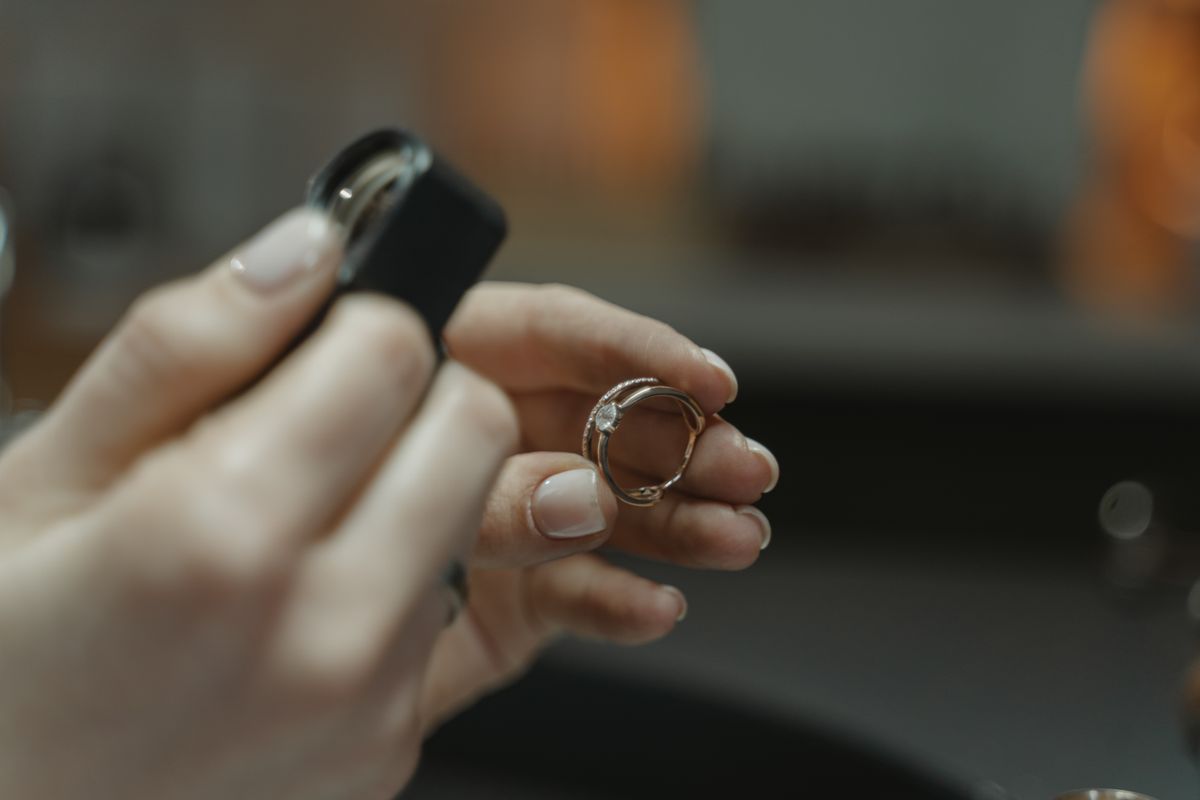
Photo: Tima Miroshnichenko via Pexels.
How to check a ring properly
If the ring is round, a jeweller’s ring mandrel gives a size reading, and callipers can measure its inner diameter. A ruler is less precise because a fraction of a millimetre matters.
When you measure a finger, use sizing rings rather than a strip of string or elastic material. GIA explains that the gauge should pass over the finger joint and settle at the place where the ring will be worn, without being forced. Choose gauges with a width similar to the intended ring and be aware that temperature and time of day affect the fit.
A wide band covers more of the finger and can feel tighter. That does not mean every wearer needs the same automatic size adjustment. Discuss a fitting with wide or comfort fit bands with your jeweller.
What to send when ordering a bespoke ring
A useful message includes the actual finger and hand, what you measured, the diameter or circumference in millimetres, any size provided by another jeweller, the measurement method and the intended band width. For example: “Left ring finger; suitable existing ring; 16.8 mm inside diameter; considering a 2.5 mm band.”
This information tells us where the uncertainties are. Send your measurements through our contact page so we can discuss them before your design is approved.
Frequently asked questions
How do I turn a diameter measurement into a circumference?
Multiply an inside diameter in millimetres by pi, approximately 3.1416. For example, 16.8 × 3.1416 = 52.78 mm, which rounds to 52.8 mm. Use this calculation only for a round ring, not an oval or a ring that has been knocked out of shape.
What size is a 16.8 mm ring diameter?
An inside diameter of 16.8 mm gives an inside circumference of about 52.8 mm, or ISO 53 to the nearest whole millimetre. GIA’s chart puts US 6½ at 16.9 mm and 53.1 mm, while UK L½ is at 16.7 mm and 52.5 mm. Check the intended size with your jeweller instead of assuming these different reference points are identical.
Is 17 mm across a ring the same as ISO 17?
No. A 17 mm inside diameter is a straight-line measurement across the ring. Multiply it by pi to estimate a 53.4 mm inside circumference, or ISO 53 to the nearest whole millimetre. A 17 mm circumference would describe a much smaller ring.
Should I choose a larger size for a wider band?
A wider band can feel tighter, but do not guess how much larger to go. GIA recommends a wide-finger sizing gauge for a ring over 4 mm wide. A fitting with a gauge close to the proposed width is the most useful starting point.