DIAMOND EDUCATION

LEARN ABOUT DIAMOND CARAT

Diamond carat: weight, size, and what it really means

Carat measures weight, not size. A diamond can be heavier than another and still look smaller face-up. Learn how carat interacts with cut, shape, and proportions to determine what you actually see on the finger.

DIAMOND EDUCATION

Diamond carat explained

What carat weight actually means, why it does not equal visual size, and how to use it alongside cut and shape to get the best-looking diamond for your budget.

THE BASICS

What carat actually measures

One carat, one fifth of a gram — and no guaranteed promise about size.

Carat is a unit of mass. One carat equals 0.2 grams, or 200 milligrams. The word derives from the carob seed, historically used as a counterweight on gemstone scales because of its consistent mass. The modern metric carat was standardised internationally in 1907.

Carat weight is stated to two decimal places on a GIA or IGI grading certificate: a 1.00ct stone weighs precisely 0.200 grams. Because weight is easy to measure and compare, carat became the shorthand for diamond size — but weight and visual size are not the same thing. Two diamonds can share the same carat weight and look meaningfully different face-up depending on how each stone is cut and what shape it is.

Price per carat increases non-linearly as diamonds approach and cross whole-number thresholds. A 0.98ct stone will cost noticeably less than a 1.00ct stone of equivalent quality, while looking virtually identical on the finger. Understanding this allows you to find better value without compromising on the appearance you want.
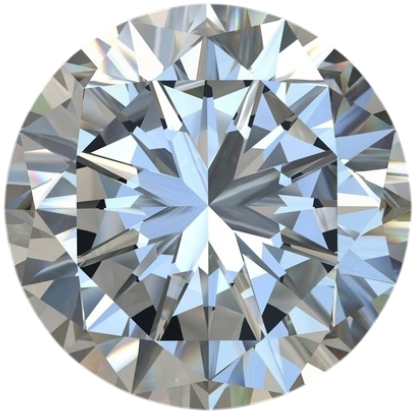
Diamond Carat Size

How carat affects size

Carat is a measure of weight, not size. Move the slider to see how diameter changes with each carat weight.

Round brilliant diamond
Millimetre reference 0 10 20
Carat weight 0.10 ct — 3.0 mm

Carat weight

0.10 ct

Diameter

3.0 mm

Approximately the size of a small grain of sand. Delicate and minimal — suited to fine stacking bands rather than solitaires.

Common sizes at a glance

Diameter values based on industry-standard round brilliant proportions. Visual scale is proportionally accurate, not physically absolute.

THE MOST COMMON MISCONCEPTION

Why carat weight does not equal visual size

A diamond’s face-up diameter — the measurement that determines how large it appears on the finger — depends on its cut proportions, not just its weight. A stone cut too deep carries significant mass in the pavilion, below the girdle, where it is invisible. The result is a diamond that weighs more but faces up smaller than a shallower, better-proportioned stone of the same carat.

A 1.00ct round brilliant cut to GIA Excellent proportions typically measures 6.4–6.5mm in diameter. The same 1.00ct stone cut too deep may measure only 6.0–6.1mm. The shallower, better-cut stone also sparkles more, because its proportions optimise light return rather than mass retention.

This interaction between cut and carat is why we always provide exact millimetre measurements alongside carat weight for every stone we shortlist. The number that matters most for visual impact is the face-up diameter — not the weight printed on the certificate.

Diamond education

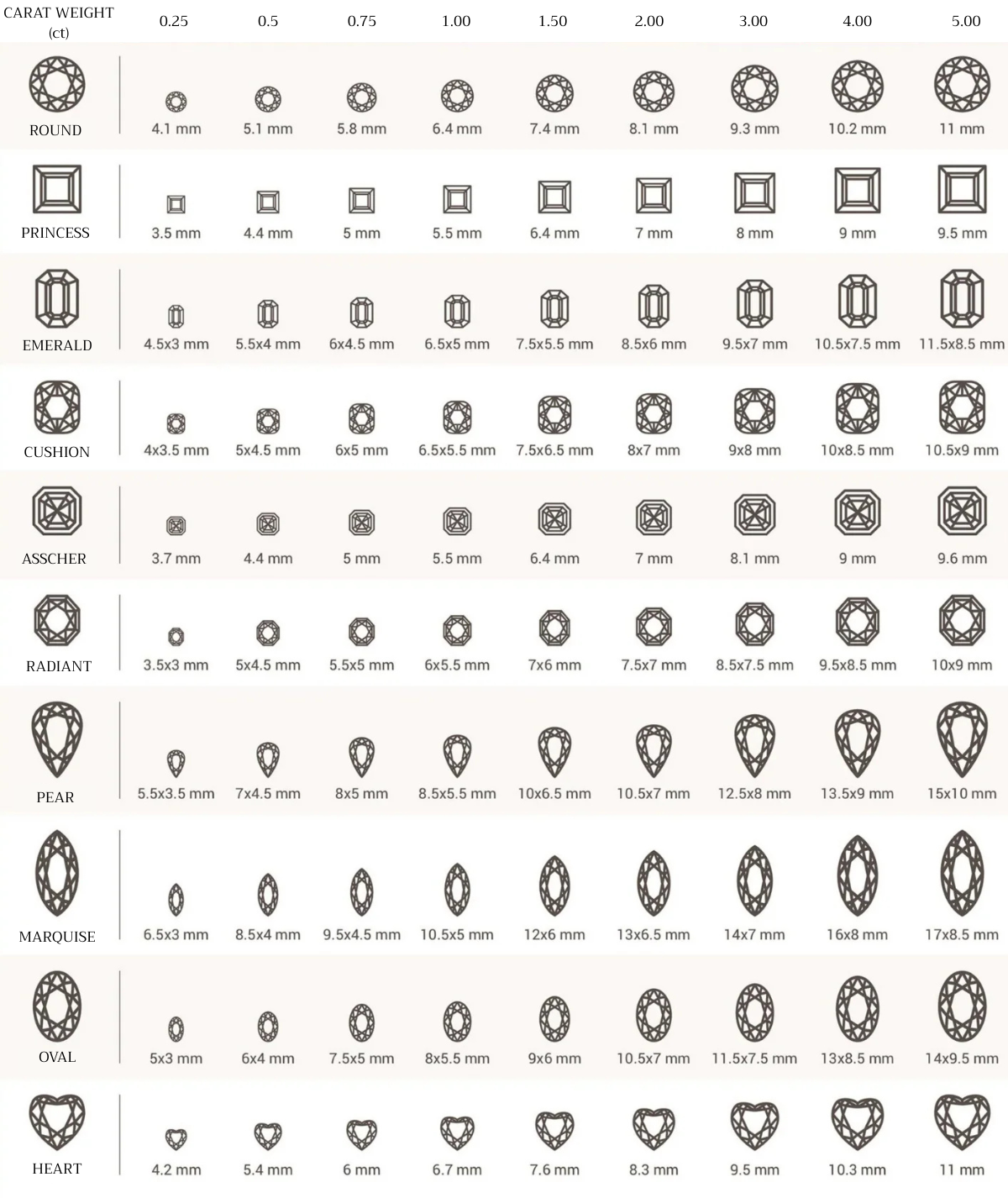
Estimated dimensions for popular shapes

Carat weight affects how large a diamond can look, but size also depends on shape and cut. Use this chart to compare typical carat weights across popular shapes, then confirm real options by their exact millimetre measurements and face up spread.

Chart displaying carat weight and corresponding dimensions for various diamond shapes including round, princess, emerald, cushion, asscher, radiant, pear, marquise, oval, and heart.

How to read this chart

Each cell shows the typical face-up size for that shape at that carat weight. Dimensions are approximate averages — actual stones vary depending on how weight is distributed. A well-cut stone always looks larger than a deeply-cut stone at the same weight.

Round 1ct averages 6.4 mm diameter — the most popular engagement ring size
Oval & marquise face up 10-15% larger than a round at the same carat weight
Pear 1ct measures approx 8.5 x 5.5 mm — longer finger coverage for the same budget
Deep cuts can make a 1.2ct stone face up like a 0.9ct — cut quality matters more than weight

SHAPE MATTERS

How diamond shape affects face-up size

Different shapes distribute the same carat weight across very different face-up areas. Elongated shapes — oval, pear, marquise, and emerald — typically cover more surface area than a round brilliant of the same weight, because their geometry spreads the mass across a larger diameter in one direction. This is why an oval or pear often appears larger face-up than a round of equivalent carat.

As a general guide, a 1.00ct round brilliant measures approximately 6.4–6.5mm in diameter. A 1.00ct oval at a classic 1.40 length-to-width ratio might measure 7.5 × 5.4mm — appearing noticeably larger from above even though both stones weigh the same. A princess cut at 1.00ct will typically measure 5.5 × 5.5mm and appear smaller than the round despite equal weight, because the square shape presents a smaller visible face.

If maximising how large a diamond looks is a priority, elongated shapes offer more visual impact per carat than rounds. If you want to stay within a specific millimetre range, the shape choice should come before the carat target.

Carat Weight Tips

Prices rise sharply at milestone weights

At weights such as 1.00ct, 1.50ct, and 2.00ct. Buying just under can offer strong value with little visible difference.

Cut affects visible size

A diamond cut too deep may face up smaller, even though it weighs the same as a better proportioned stone.

Shape changes spread

Oval, pear, and marquise often look larger than a round at the same carat weight due to their length.

Choosing the right carat weight

Best value ranges

0.70ct to 1.20ct is a popular range for engagement rings because it offers strong presence without the steepest milestone premiums.

If you want maximum size for budget, consider just under key thresholds, such as 0.90ct to 0.99ct, or 1.40ct to 1.49ct.

How to look bigger

millimetre spread , not just weight. A diamond that carries weight in depth can face up smaller.

Elongated shapes, such as oval, pear, and marquise, often look larger than a round at the same carat weight.

What we compare for you

exact dimensions in mm , face up spread, and cut proportions, then explain the trade offs clearly.

This is the quickest way to answer what does 1 carat look like; shape and cut change the result.

PRACTICAL GUIDANCE

Carat ranges and what they look like on the finger

Below 0.50ct, diamonds are generally used as accent stones, halos, or in eternity bands. As a centre stone, sub-0.50ct stones suit simpler settings and certain aesthetic preferences well.

0.50–0.79ct covers a meaningful range. These stones are visually impactful, especially in oval or pear shapes, and can look excellent in solitaires and bezel settings. They represent strong value when cut quality is kept high.

0.80–0.99ct is often the sweet spot for buyers balancing visual size and price. A well-cut 0.90ct round sits very close in appearance to a 1.00ct stone while typically falling below the price threshold that makes 1.00ct stones noticeably more expensive per carat.

1.00–1.49ct is the most commonly requested range for engagement rings. Prices rise steeply at the 1.00ct mark; stepping down to 0.96–0.99ct with no visible compromise is a strategy we use regularly. Above 1.50ct, each additional tenth of a carat commands a meaningful premium, and clarity and colour grading become more important as inclusions are easier to see in larger stones.

Diamond carat weight explained by GIA

In this video, GIA explains how carat weight is measured and why carat is not the same as visible size. Learn how millimetre dimensions, shape, and cut proportions influence face up spread, and why two diamonds with the same carat weight can look different once set.

OUR RECOMMENDATION

How to get the best visual impact for your budget

Prioritise cut quality first, then choose a carat weight that delivers the face-up diameter you want. A well-cut 0.90ct round brilliant will look larger and more brilliant than a poorly-cut 1.10ct stone — and cost less.

Just below psychological carat thresholds (0.90–0.99ct, 1.45–1.49ct) often offers the best value. The price-per-carat premium that applies at 1.00ct and 1.50ct does not apply just below those marks, but the visual difference is negligible. We routinely source stones in these ranges for clients who want a specific look without paying the threshold premium.

For elongated shapes, consider targeting a face-up diameter rather than a carat weight. An oval measuring 7.5mm in its longest dimension will look a particular size regardless of whether the certificate reads 0.92ct or 1.05ct. We provide millimetre measurements with every stone we shortlist so you can compare visually, not just by weight. When you are ready, get in touch and we will put together options based on what you actually want to see.

Everything you need to know

Frequently asked questions about diamond carat

A 1.00ct round brilliant cut to GIA Excellent proportions measures approximately 6.4–6.5mm in diameter. However, the exact measurement depends on cut proportions. A 1.00ct stone cut too deep may measure only 6.0–6.1mm face-up. For other shapes, a 1.00ct oval at a 1.40 length-to-width ratio typically measures around 7.5 × 5.4mm. We provide exact millimetre measurements for every stone we shortlist.

Diamond prices increase non-linearly at whole-number carat thresholds because demand concentrates around round numbers. The price-per-carat of a 1.00ct stone is meaningfully higher than a 0.98ct stone of identical cut, colour, and clarity. The visual difference between those two weights is essentially zero. Targeting just below these thresholds — 0.90–0.99ct or 1.45–1.49ct — is one of the most reliable ways to improve value without compromising appearance.

Elongated shapes generally appear largest face-up for the same carat weight. Marquise and oval cuts in particular spread their mass across a larger surface area than round brilliants. A 1.00ct oval will typically appear larger than a 1.00ct round, and a 1.00ct marquise larger still. Princess and asscher cuts, conversely, tend to face up smaller than rounds of the same weight because the geometry is more compact.

Cut quality, in almost all cases. A well-cut stone at a lower carat weight will look larger and more brilliant than a poorly-cut stone at a higher weight. Cut is the only one of the 4Cs that is entirely within the craftsman’s control — it is where quality is made, not found. We recommend securing a GIA Excellent or equivalent cut grade first, then choosing the highest carat weight within your budget that meets that standard.

Yes. Carat is a measure of mass, and a lab-grown diamond is physically identical to a natural diamond — the same carbon crystal structure, the same density. A 1.00ct lab-grown diamond weighs exactly the same as a 1.00ct natural diamond and faces up at the same diameter. The only difference between them is origin, not physical properties.

Smaller fingers make diamonds appear proportionally larger, and larger fingers can make the same stone appear less prominent. A 0.80ct round brilliant may look substantial on a size 5 finger and more modest on a size 8. This is worth considering when targeting a specific look: buyers with smaller fingers can often achieve the visual impact they want at a lower carat weight than buyers with larger hands.

Every diamond we source is independently certified by either the Gemological Institute of America (GIA) or the International Gemological Institute (IGI). The certificate and direct verification link are provided with every piece so you can confirm the grading report before any commitment is made.

Still have a question? Our team typically responds within one business day.

Our process

How we help you choose online

Buying a diamond online without being able to see it demands a different kind of service. Here is exactly how we work.

  • Sourced to order

    We do not hold stock. Every diamond is sourced fresh for you from a network of trusted suppliers and marketplaces — which means access to a far wider selection than any single showroom could carry.

    Once you choose a stone, we confirm availability and secure it before any work begins on your setting.

    Selection Thousands of stones, filtered for you

  • Shortlisted with guidance

    You receive a curated shortlist with certificates, precise millimetre measurements, and plain-language notes on what each clarity grade means for that specific shape and size.

    We explain the trade-offs — size versus clarity, cut versus colour — so you can decide based on what you actually care about, not just what looks good on paper.

    Turnaround Shortlist within 1–2 business days

  • Checked for visibility and risk

    Before anything is confirmed, we assess each shortlisted diamond for inclusions likely to be visible face-up, clouds that affect transparency, and durability concerns — particularly surface-reaching features in vulnerable positions.

    If a stone is a poor bet at its price, we say so and offer a better alternative.

    Our standard Eye-clean unless you request otherwise

    How we work

Diamond education

The four Cs — what they mean for your diamond

Cut, colour, clarity, and carat weight each affect what you see and what you pay. Understanding the trade-offs is how you get the best stone for your budget.

The 4 Cs

Cut

Cut is the single biggest driver of brilliance. A well-cut stone returns light cleanly to the eye — a poorly cut one looks flat, whatever its colour or carat weight. We prioritise Excellent and Ideal grades for every stone we source.

The 4 Cs

Colour

Colour grades how colourless a diamond appears on a D–Z scale. The difference between D and G is invisible to most eyes — but significant on price. We guide you to the grade where you stop noticing and start saving.

The 4 Cs

Clarity

Clarity grades the size and position of inclusions inside the stone. Most are invisible to the naked eye — a VS2 or SI1 in the right stone looks identical to a flawless grade in everyday wear, at a meaningful saving.

The 4 Cs

Carat

Carat is weight, not size — and the two do not always agree. Shape and cut affect how large a diamond looks on the finger. A 0.90ct well-cut oval will often appear larger than a 1.05ct round with a mediocre cut.

Want guidance on carat weight and size?

Standards & Provenance

Certified and responsibly sourced

Every diamond we supply is independently graded and responsibly sourced.

IGI — International Gemological Institute

IGI Certified Diamonds

Diamonds independently graded by IGI for cut, colour, clarity, and carat.

Independent grading
GIA — Gemological Institute of America

GIA Certified Diamonds

Diamonds graded by GIA, widely recognised as the global standard for diamond certification.

Global standard
Kimberley Process Certification Scheme

Kimberley Process Compliant

Diamonds sourced in compliance with the Kimberley Process to prevent conflict diamonds.

Conflict-free sourcing