Bespoke engagement rings in Manchester, designed across the UK
Commission a bespoke engagement ring with clear guidance on stone choice, setting style, metal, budget and final approval. Based in Manchester and working remotely across the UK, À Vie designs each ring around the brief before anything is made.
Every bespoke engagement ring involves the same core decisions: centre stone, setting style, metal, profile, budget and timeline. We guide each choice so the finished ring feels personal, practical and proportionate.
09 design decisions
Select any step to expand
01
Ring Style
The overall design language — minimal and contemporary, classic solitaire, vintage-inspired, or fully custom with no reference point. Style sets the direction for every decision that follows. Most clients come with a loose idea or a few images. You don't need to know exactly what you want before we speak.
A good starting point is a few saved images
02
Ring Setting
The setting is how the stone is held. A prong or claw setting lifts the stone and maximises light through it. A bezel wraps the stone in metal — more protective, more contemporary. Tension, channel, and pavé settings each have their own look and practical trade-offs. We match setting to stone shape, lifestyle, and style direction.
Affects both look and wearability
03
Centre Stone
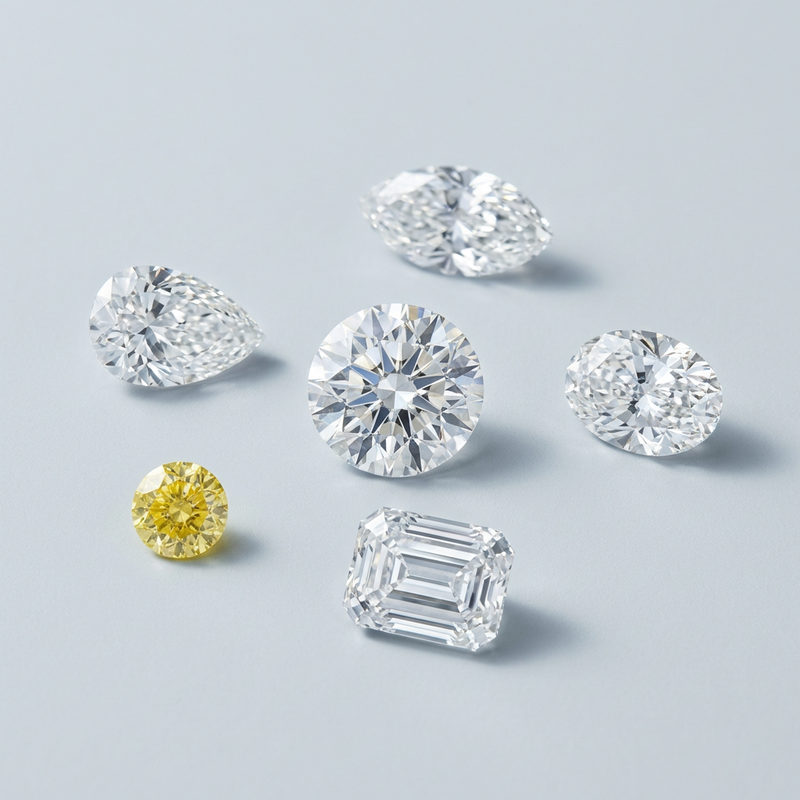
Shape, size, quality, and origin — the four decisions within the stone itself. Shape determines character; round brilliants maximise sparkle, fancy shapes like oval and pear appear larger for the same carat weight. Natural and lab-grown diamonds are chemically identical — lab stones typically cost 60–80% less. Every stone we source is GIA or IGI certified.
GIA and IGI certified only
04
Additional Stones
Side stones, shoulder diamonds, or a halo around the centre stone add brilliance and visual presence without increasing the centre stone size. A three-stone design carries its own meaning — past, present, future. Additional stones are optional, fully itemised in your quote, and certified separately.
Optional — fully itemised if included
05
Band Decoration
Diamonds or gemstones set into the band itself — pavé, channel, or flush-set along part or all of the band. Band decoration adds continuous brilliance and suits styles where the ring is meant to be worn as a statement. It also affects how the ring pairs with a wedding band, so it’s worth considering both together.
Worth planning alongside your wedding band
06
Finishing
The surface treatment of the metal. A full polish gives a mirror-bright finish — classic and high-contrast. Satin or brushed finishes are softer, more forgiving of everyday marks, and suit contemporary styles. Finishes can be mixed on the same ring — polished setting with brushed band, for example.
Often overlooked, always worth discussing
07
Engraving
Text, a date, initials, or a personal symbol on the inside of the band. Machine engraving is precise and consistent. Hand engraving has a subtly varied quality that is unique to each ring. Both are permanent. Character count depends on band width and ring size. Engraving is confirmed closer to completion.
Confirmed closer to completion
08
Metal Choice
Platinum is the most durable and stays white permanently — the benchmark for fine engagement rings. 18ct white gold looks similar but requires occasional rhodium plating to maintain its colour. 18ct yellow and rose gold suit warmer skin tones and pair naturally with fancy-cut stones. Metal also influences how a diamond’s colour appears.
We work in platinum and 9ct–18ct gold
09
Ring Size
Finger size varies with temperature, time of day, and season — typically larger in summer and in the afternoon. We size carefully to account for this. If you’re planning a surprise proposal, we can advise on how to estimate. One complimentary resize is included within three months of delivery.
One free resize included
Your first consultation is free. No obligation, no pressure.
Finger size changes with temperature, time of day and band width, so we treat sizing as part of the design process rather than an afterthought. Our ring sizing guide explains how to measure at home, compare UK, US and EU/ISO sizes, and understand how width and profile affect fit.
Every bespoke engagement ring starts with a budget. The important question is where that budget goes. In a lean, appointment-led, made-to-order model, more of the spend can be focused on the stone, the metal, the design choices and the craft of the finished ring.
That is the practical advantage of working directly with a small bespoke jeweller.
Direct guidanceYou work through the choices with us, not through a scripted retail sales process.
Made to orderNothing is made until the stone, design and price are approved.
Visible valueWe prioritise the elements that affect beauty, durability and daily wear.
Stone, metal, design and craftRetail and operating overheadMargin or return
Illustrative comparison based on public retail disclosures, industry benchmarks and typical made-to-order engagement-ring pricing structures. Retail cost models vary by brand, specification, location and service model. This is not a like-for-like price comparison with any named jeweller.
Ring settings
Engagement ring styles
Choose a setting that suits your lifestyle and design vision. Each style is engineered for security, comfort, and proportion.
9
setting styles
Select a setting style to explore it
01
Solitaire
A classic single stone that puts the diamond first
02
Halo
A frame of diamonds that amplifies sparkle and apparent size
03
Side Stone
Shoulder stones that add brilliance and visual width
04
Trilogy
Three stones symbolising past, present, and future
05
Toi et Moi
Two stones side by side — modern and deeply personal
06
Cluster
Multiple diamonds arranged for maximum sparkle and character
07
Bezel
A smooth metal rim that protects and frames the stone
08
Flush
Stone sits level with the band surface for a minimal profile
09
Tension
The stone appears suspended between two ends of the band
Solitaire
Classic · Timeless · Stone-forward
The solitaire is the most enduring engagement ring design in the world. A single diamond, held aloft by prongs or a bezel, with nothing to compete for attention. Its restraint is its power. It works in every era, every setting material, and at every budget level.
Best shapesRound · Oval · Princess · Cushion · Emerald
Metal recommendationAll metals · especially platinum for longevity
A halo surrounds the centre stone with a circuit of smaller diamonds, creating a continuous field of light. The effect amplifies the apparent size of the centre stone by 10 to 20 percent and adds significant brilliance. Particularly effective with cushion, round, and oval centre stones.
Best shapesRound · Cushion · Oval · Pear · Heart
Metal recommendationWhite gold or platinum to maximise contrast and sparkle
Side stones flank the centre diamond on the shoulders of the band, adding brilliance and a sense of visual balance. Tapered baguettes create a sleek, architectural look; round brilliants add warmth and sparkle.
Best shapesRound · Emerald · Princess · Oval
Metal recommendationYellow gold or platinum · both complement the design beautifully
A trilogy ring places three diamonds of complementary size and shape along the band. The design carries powerful symbolism and delivers a broad, balanced appearance with three distinct light sources.
Best shapesRound · Oval · Cushion · Emerald (centre)
Metal recommendationPlatinum or white gold to unify the three stones visually
Toi et Moi sets two stones side by side, sometimes in contrasting shapes or a slight twist, to create a ring that feels both modern and deeply intimate. The design has strong art-historical roots and has experienced a major revival in contemporary fine jewellery.
A cluster ring groups multiple diamonds into a single composition that reads as one larger stone from a distance. Cluster rings deliver exceptional sparkle at a fraction of the cost of a single large stone and allow for highly creative, personalised designs.
Best shapesRound melee · varied shapes for artistic clusters
Metal recommendationYellow gold for a vintage feel · platinum for a modern edge
A bezel setting encircles the girdle of the diamond with a continuous rim of metal, holding it securely and protecting the edges. The result is a clean, architectural profile that reads as distinctly modern. Excellent for active lifestyles.
Best shapesRound · Oval · Cushion
Metal recommendationPlatinum or yellow gold · the metal rim is highly visible
Price tier$$ Mid — moderate metalwork complexity
CharacterMinimal · secure · architecturally modern
A flush setting recesses the stone into the metal so its table sits level with the band surface. The result is an extremely low-profile, snag-free ring ideal for very active wearers or those who prefer understated jewellery.
Best shapesRound · small princess
Metal recommendationYellow gold · the metal plays a dominant visual role
A tension setting uses the compression force of the metal band to hold the stone in place without any visible prongs, bezel, or base. The stone appears to float, held purely by pressure. A dramatic, architectural choice.
Best shapesRound · Princess · Oval
Metal recommendationPlatinum or hard-alloy white gold · tension mechanics require specific metal hardness
The setting type determines how high your diamond sits above the band, how much light reaches it, and how well it is protected for daily wear. Ordered from lowest to highest profile.
8
setting types
Lowest profileHighest profile
Select a setting type to explore it
01
Flush / Gypsy
Stone recessed into the band — lowest profile possible
02
Channel
Stones sit inside a groove in the band — flush and secure
03
Bezel
A continuous metal rim encircles and protects the stone
04
4-Claw Prong
Four metal claws lift the stone above the band
05
6-Claw Prong
Six claws create a rounder silhouette and added security
06
Basket
An open framework of metal lifts and cradles the stone
07
Cathedral
Arched metal buttresses raise the stone to a dramatic height
08
Tension
The stone floats between two band ends, held by compression alone
Flush / Gypsy
Lowest profile · Zero snag · Maximum protection
The flush setting, also called a gypsy or burnish setting, recesses the diamond fully into the metal so its table sits level with the band surface. There are no prongs, no rim, and no projecting element of any kind. The metal is pushed inward over the stone’s girdle using a burnishing tool, locking it permanently in place. This is the most protective setting for an active lifestyle and produces an extremely clean, minimal aesthetic. Light entry is the most restricted of any setting type.
Best shapesRound · small Princess
Metal recommendationYellow gold — the metal plays a dominant visual role
Price tier$ Entry — most affordable
ResizabilityEasy — no setting elements affected by resizing
Flush
Elevated
Advantages
Zero snagging risk whatsoever
Extremely durable — no raised elements to damage
Stone fully protected on all sides
Ultra-low profile for practical daily wear
Considerations
Very limited light return — stone sits in shadow
Not suitable for larger stones above approximately 0.5ct
Channel setting places a row of diamonds inside a continuous groove cut into the metal band. The stones are held by the channel walls on either side rather than by individual prongs. The top of each stone sits level with or just fractionally above the band surface, creating a smooth, uninterrupted line of brilliance. Channel setting is most commonly used for eternity-style bands and as a complement to a solitaire centre stone.
Best shapesRound · Princess · Baguette
Metal recommendationAll metals — particularly effective in yellow gold
Price tier$$ Mid — moderate complexity
ResizabilityLimited — channel walls must be cut and rejoined; specialist work required
Flush
Elevated
Advantages
No individual prongs to snag
Very secure stone retention across the whole row
Clean, flush appearance with continuous sparkle
Excellent comfort for active wearers
Considerations
Difficult to resize after setting
Individual stones less brilliant than prong-set equivalents
Stone loss requires specialist repair to the channel wall
A bezel setting encircles the entire girdle of the diamond with a continuous wall of metal, holding it securely in a custom-formed seat. The stone sits above the band surface but is fully enclosed on all sides, making this the most secure setting for a single centre stone. Full bezels enclose the entire girdle; partial or semi-bezels expose the sides for more light entry and a lighter appearance. As noted in our design framework, full bezel combined with a halo requires skilled bench work to step the outer bezel wall down to the correct height.
Best shapesRound · Oval · Cushion
Metal recommendationPlatinum or yellow gold — the metal rim is highly visible and forms part of the design
Price tier$$ Mid — moderate complexity
ResizabilityModerate — bezel must be carefully opened and reformed if resizing significantly
Flush
Elevated
Advantages
Most secure single-stone setting available
Protects the stone’s girdle and edges completely
Sleek, contemporary aesthetic with strong metal presence
Ideal for active wearers who want a substantial stone
Considerations
Less light enters the stone compared to prong settings
The metal rim can make the stone appear slightly smaller
Full bezel is not compatible with certain ring styles without modification
Mid profile · Maximum light · Classic open setting
A four-claw prong setting holds the diamond by its girdle with four metal claws arranged at the cardinal points. The stone sits elevated above the band, with open space on all sides allowing light to enter from every angle. Four claws give the stone a subtly square silhouette when viewed from above. This is the most common engagement ring setting and offers the best balance of security, light return, and ease of cleaning.
Best shapesRound · Oval · Princess · Cushion
Metal recommendationAll metals — platinum recommended for prong longevity
Price tier$ Entry — most affordable
ResizabilityEasy — prong setting is unaffected by standard resizing
Flush
Elevated
Advantages
Maximum light return from all angles
Full visibility of the stone’s girdle and pavilion
Easiest setting to clean — full access around and underneath
Most widely available and easily repaired
Considerations
Prongs can snag on fabric, hair, or gloves
Prong tips require periodic re-tipping as they wear
Stone is more exposed to impact than bezel or flush settings
Four prongs give a slightly square silhouette some prefer to avoid
Mid-high profile · Round silhouette · Extra security
A six-claw prong setting works on the same principle as four-claw but uses two additional claws to create a rounder, more enclosed silhouette around the stone. The extra metal contact at six equidistant points adds security and is particularly effective with round brilliant diamonds, where it emphasises the stone’s circular form. The Tiffany-style six-claw setting is perhaps the most recognised engagement ring design in the world.
Best shapesRound brilliant — the setting is optimised for this shape
Metal recommendationAll metals — platinum especially recommended for the long-term integrity of six fine prong tips
Price tier$ Entry — most affordable
ResizabilityEasy — prong setting is unaffected by standard resizing
Flush
Elevated
Advantages
Greater security than four-claw with more stone contact points
Rounder silhouette strongly complements the round brilliant
Iconic, widely recognised design language
Still allows excellent light entry
Considerations
Slightly more metal visible around the stone than four-claw
Six individual prong tips require the same periodic re-tipping maintenance
Mid-high profile · Open gallery · Light-maximising
A basket setting uses a framework of horizontal and vertical metal elements beneath the stone to form an open cage or basket structure. The stone sits elevated in the basket head, which is then secured to the ring shank. The open structure maximises light entry from below the stone, enhancing brilliance compared to a closed-back setting. As noted in our design framework, combining a basket setting with a low-set shank requires redesigning the setting head with a shorter peg and wider base — a standard basket cannot simply be lowered without weakening the prong base.
Best shapesRound · Oval · Cushion · Princess
Metal recommendationPlatinum or white gold for a light, open appearance; yellow gold for warmth
Price tier$$ Mid — moderate complexity
ResizabilityEasy to moderate — basket head is separate from shank in most designs
Flush
Elevated
Advantages
Open gallery maximises light entry beneath the stone
Elegant, refined appearance with visible craftsmanship
Strong platform for the stone with a structured aesthetic
Can be combined with most ring styles
Considerations
Higher profile than bezel or prong settings — more exposed
The open basket can accumulate debris requiring regular cleaning
Not recommended for very active lifestyles due to height
High profile · Dramatic elevation · Architectural grandeur
A cathedral setting uses sweeping arches of metal, resembling the flying buttresses of a Gothic cathedral, to lift the stone to a significant height above the band. The arches run along the shank and meet the setting head, framing the stone in a way that adds visual drama and considerable presence. The elevated position maximises light entry from all directions. As noted in our design framework, cathedral settings with very short prong tips are harder to re-tip; the arch geometry restricts bench jeweller access, so specifying accessible prong tips is advisable.
Best shapesRound · Oval · Cushion · Pear — larger stones make the most of the elevated platform
Metal recommendationPlatinum or white gold for a clean, architectural line; yellow gold for a warmer, more romantic interpretation
Price tier$$$ Premium — intricate craftsmanship
ResizabilityModerate — the cathedral arches complicate but do not prevent resizing in most cases
Flush
Elevated
Advantages
Dramatic visual presence — the most striking silhouette of any setting type
Maximum light entry from all angles due to elevation
Strong design statement that frames the stone architecturally
The arches can incorporate pavé or milgrain for additional detail
Considerations
Highest snag risk of any setting type
Stone is most exposed to impact from the sides
More difficult to clean inside the arches
Prong re-tipping requires specialist access; confirm with bench jeweller
A tension setting holds the diamond entirely by the compressive force of the metal band itself. Two precisely machined seats are cut into the opposing ends of a split band, and the stone is pressed into place using the spring tension of the metal. No prongs, no bezel, and no base are visible — the stone appears to float in mid-air. As documented in our design framework, tension settings are physically incompatible with halo, trilogy, and cluster ring styles, as there is no structural mechanism for surrounding or adjacent stones. Tension settings also cannot be resized after manufacture. The metal alloy must be selected with engineering precision — typically platinum or a hard-grade white gold.
Best shapesRound · Princess · Oval — stone must fit precisely into machined seats
Metal recommendationPlatinum or hard-alloy white gold only — the tension mechanism requires specific metal hardness and spring properties
Price tier$$$ Premium — intricate craftsmanship
ResizabilityNot possible — the tension mechanism is destroyed by resizing; size must be confirmed precisely before manufacture
Flush
Elevated
Advantages
Extraordinarily distinctive appearance — unlike any other setting
Maximum light entry from every direction with no obstructions
The stone is the complete and undisputed visual focus
Conversation piece — the engineering is visually apparent
Considerations
Cannot be resized under any circumstances — size accuracy is critical
Requires specialist repair if the band is bent or damaged
The floating stone is more exposed than any other setting type
Incompatible with halo, trilogy, cluster, and multi-stone ring styles
Compare the overall prong setup first, then refine the type of prong tip and finish.
18
prong options
First decision
Prong setup
Choose the overall prong arrangement first — two, four, six, rotated, or bespoke. This determines how the stone is held before you refine the style of the prong tips themselves.
01
Two Prong
02
Three Prong
03
Four Prong
04
Six Prong
05
Eight Prong
06
Bespoke
Second decision
Prong type
Then compare the tip shape and finish of the prong itself — claw, button, block, tab, V-tip, double, and decorative variants. These affect the character and practical feel of the setting.
01
Baby Claw Prong
02
Claw Prong
03
Button Prong
04
V Prong
05
Tab Prong
06
Heart Prong
07
C Prong
08
Double Prong
09
Double Claw Prong
10
French / Fishtail Prong
11
Roundelle Prong
12
Pavé Prong
Two Prong
2 claws
Two prongs positioned opposite each other for a very open, minimal presentation of the stone.
Best forRound, oval, elongated stones
Usually best reserved for carefully proportioned stones and considered design briefs.
WearabilityLow
Minimal contact means it suits lighter wear and stone-specific designs.
The way diamonds are set into the band changes everything — from sparkle and texture to wearability and maintenance. Explore each technique below.
8
styles
01
Pavé
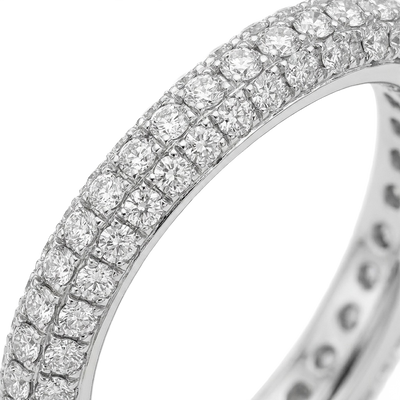
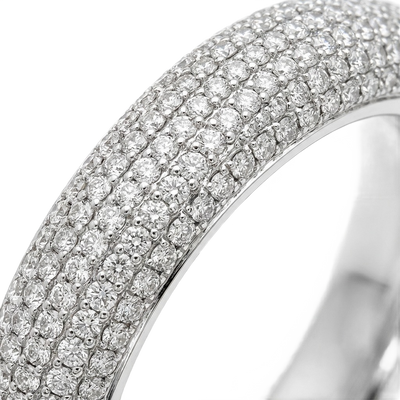
A continuous surface of micro-set diamonds
02
Micro-Pavé
Finer, more delicate pavé with smaller stones
03
Fishtail/French Pavé
Shaped metal between stones creates a distinctive scalloped pattern
04
Channel Set
Diamonds sit flush inside a continuous groove in the band
05
Bar Set
Stones held between vertical metal bars along the band
06
Bead Set
Small metal beads raised around each individual stone
07
Grain Set
A finer variation of bead setting with a more continuous surface
08
Flush Set
Stones set level with the band surface for a minimal, protected look
Pavé
Brilliant · Luxurious · Seamless
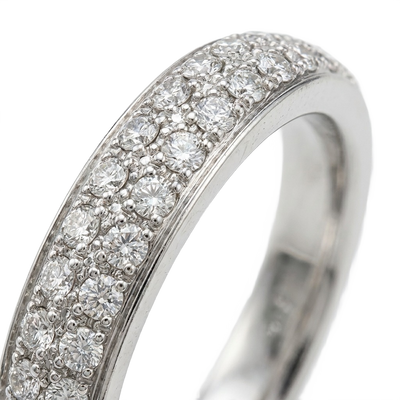
Pavé — from the French for paved — covers the band surface with small diamonds held by tiny beads of raised metal, creating an unbroken field of light across the shank. The technique can be applied to the full band or just the shoulders, and pairs beautifully with almost any centre stone setting.
CoverageShoulders · half band · full band
Stone size1.2–1.5mm round melee
Metal recommendationWhite gold or platinum — allows the diamond surface to dominate
Price tier$$$ Premium — intricate hand setting required
Micro-pavé uses smaller stones — typically under 1.2mm — set with even finer beads of metal than standard pavé. The result is a more delicate, almost fabric-like texture that reads as extremely refined and feminine. Requires exceptional bench skill to execute well.
CoverageShoulders · half band
Stone size0.8–1.1mm round melee
Metal recommendationPlatinum or white gold — fine metalwork is most visible in cooler metals
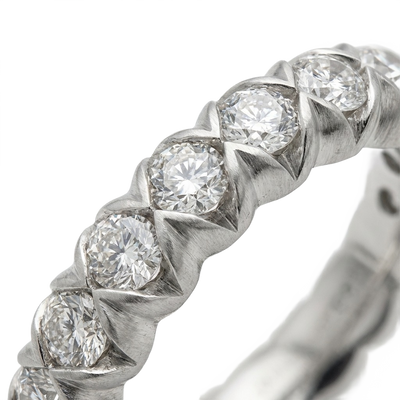
In fishtail pavé, the metal between each stone is carved into a pointed or scalloped fishtail shape, creating a repeating decorative pattern across the band. The technique has a strong vintage and antique jewellery heritage and delivers additional visual texture beyond the stones themselves.
CoverageShoulders · half band
Stone size1.2–1.5mm round melee
Metal recommendationYellow gold or rose gold — the warm metal complements the vintage aesthetic
Price tier$$$$ Bespoke — maximum complexity
CharacterVintage-inflected · textured · artisan
Advantages
Highly distinctive — visually different from standard pavé
Strong artisan and vintage character
Beautiful when viewed from multiple angles
Considerations
Requires exceptional bench skill — fewer jewellers can execute it well
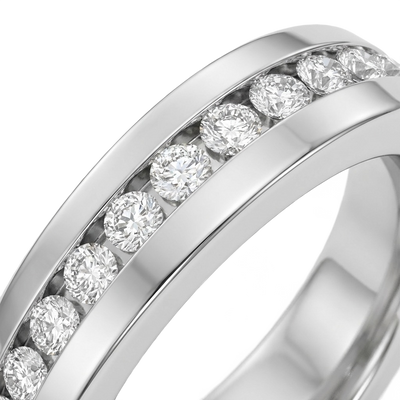
A channel setting places a row of diamonds inside a continuous groove machined into the metal band, with no individual prongs or beads holding each stone. The diamonds sit flush with the channel walls, producing a smooth, snag-free surface that is extremely practical for daily wear.
CoverageFull band · half band · shoulders
Stone size1.5–2.0mm round or princess cut
Metal recommendationAll metals — particularly effective in yellow gold for a classic look
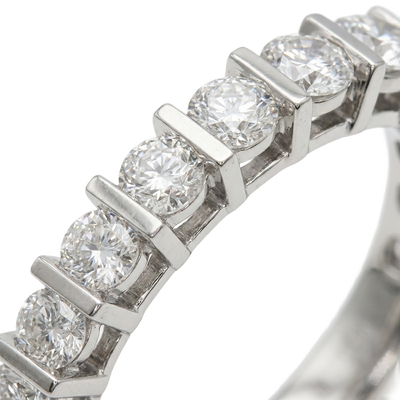
Bar setting holds each stone between two upright metal bars that run perpendicular to the band, creating a clean geometric rhythm. Light can enter through the open sides, and the design suits baguette and princess cuts particularly well, producing a strongly architectural result.
CoverageHalf band · full band · shoulders
Stone sizeBaguette · princess · 1.5–2.0mm round
Metal recommendationWhite gold or platinum — graphic lines read best in cooler metals
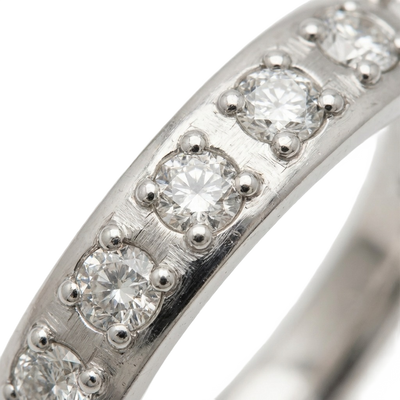
In bead setting, small beads or grains of metal are raised from the surface around each stone using a graining tool, holding it individually in place. The technique has deep roots in antique and Victorian jewellery and gives the band a distinctly handcrafted, textured quality.
CoverageShoulders · half band · scattered patterns
Stone size1.0–1.5mm round melee
Metal recommendationYellow gold or rose gold — warm metals complement the artisan aesthetic
Price tier$$$ Premium — intricate hand setting required
Grain setting is a close relative of bead setting, using smaller, finer grains of metal raised between very closely spaced stones. The result feels more continuous than traditional bead setting and can approach the density of pavé while retaining the individual grain character.
CoverageShoulders · half band
Stone size0.9–1.2mm round melee
Metal recommendationYellow gold or platinum — both suit the fine surface texture
Price tier$$$ Premium — intricate hand setting required
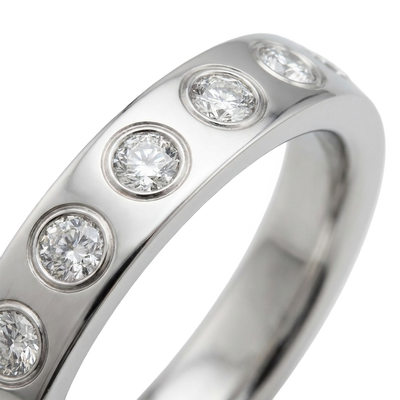
In a flush or burnish setting, each stone is recessed into a drilled hole in the metal and the surrounding metal is pushed over the girdle using a burnishing tool, locking it in place with the table level with the band surface. There are no prongs, beads, or raised elements.
CoverageScattered · full band · half band
Stone size1.5–2.5mm round
Metal recommendationYellow gold — the metal plays a dominant visual role with this setting
The stone you choose determines the character, colour, and care requirements of your ring. Each has its own personality.
Diamond
Timeless · Brilliant · Durable
Timeless, durable, and exceptionally brilliant. The classic choice for anniversaries and milestone gifts.
Hardness10 / Mohs
DurabilityExceptional
Colour rangeD–Z scale
Diamonds are the hardest natural material on earth, scoring 10 on the Mohs scale. They offer unmatched brilliance and fire.
Excellent for daily wear. Resistant to scratching. A secure setting is recommended for very active wearers.
Clean with warm soapy water and a soft brush. A periodic professional clean helps maintain peak brilliance.
Best paired withPlatinum or 18ct white gold — allows the diamond brilliance to lead
Sapphire
Deep · Durable · Vivid
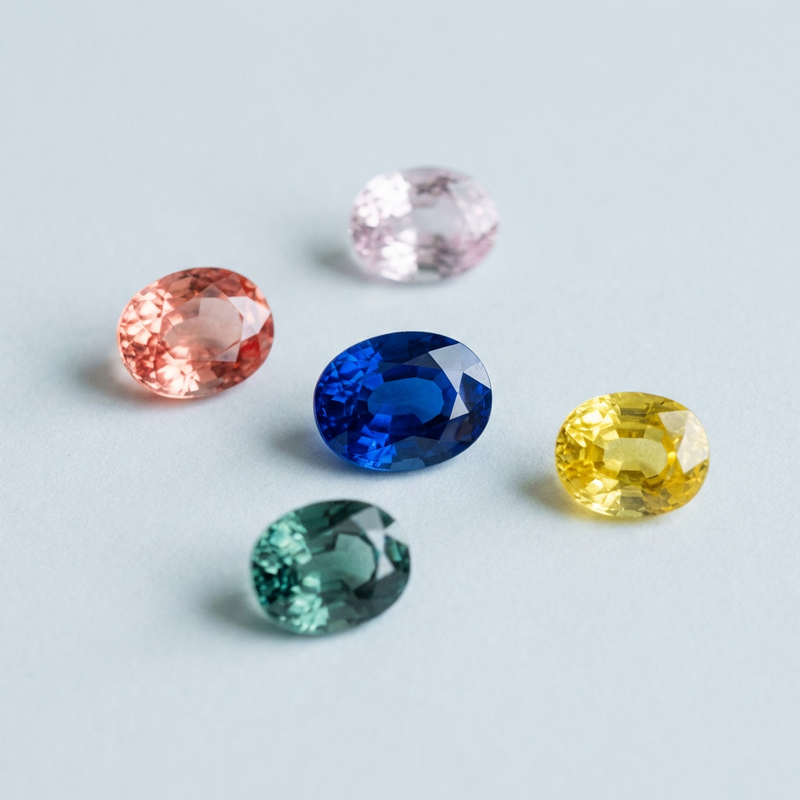
Deep blues or vibrant colours with excellent durability. A beautiful contrast in 18ct yellow gold or platinum.
Hardness9 / Mohs
DurabilityExcellent
Colour rangeBlue, pink, yellow
Sapphires score 9 on the Mohs scale. Available in a wide range of colours — most notably deep cornflower blue.
Excellent for daily wear. The high hardness makes sapphires resistant to scratching.
Clean with warm soapy water and a soft brush. Avoid ultrasonic cleaners for heavily included stones.
Best paired with18ct yellow gold or platinum — both complement the depth of blue beautifully
Emerald
Rich · Distinctive · Luxuriant
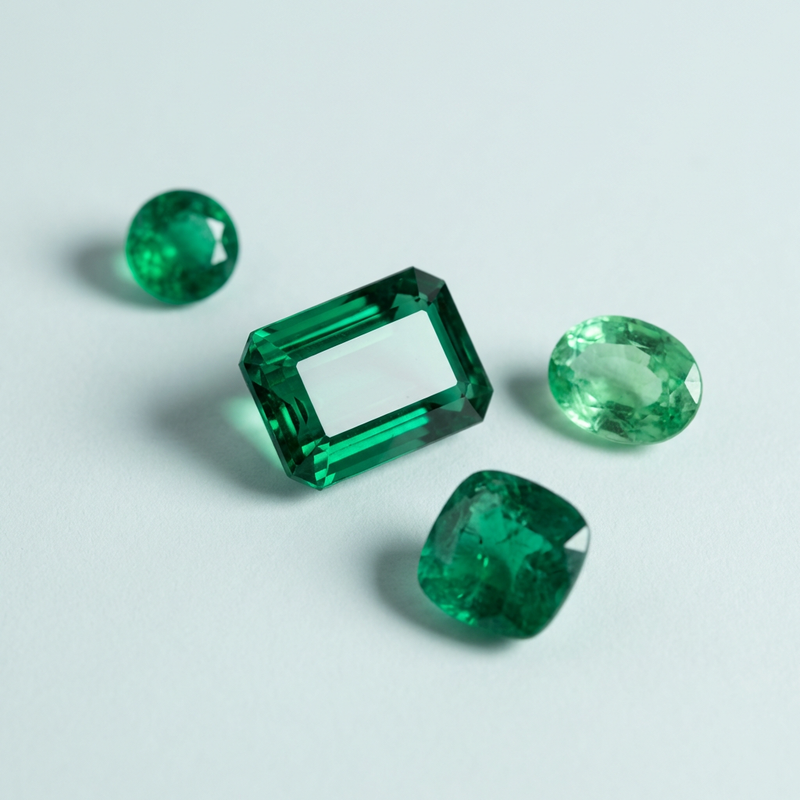
Rich green colour with distinctive character. Best suited to careful daily wear. A statement stone with deep history.
Hardness7.5–8 / Mohs
DurabilityGood with care
Colour rangeLight to deep green
Emeralds score 7.5–8 on the Mohs scale. Their rich colour comes from chromium. Natural inclusions — the jardin — are part of the stone’s character.
Moderate. A protective setting such as bezel or channel is strongly recommended for daily wear.
Clean gently with a damp cloth. Avoid ultrasonic cleaners and steam.
Best paired with18ct yellow gold — the warmth of gold enhances the richness of the green
Ruby
Bold · Symbolic · Vivid
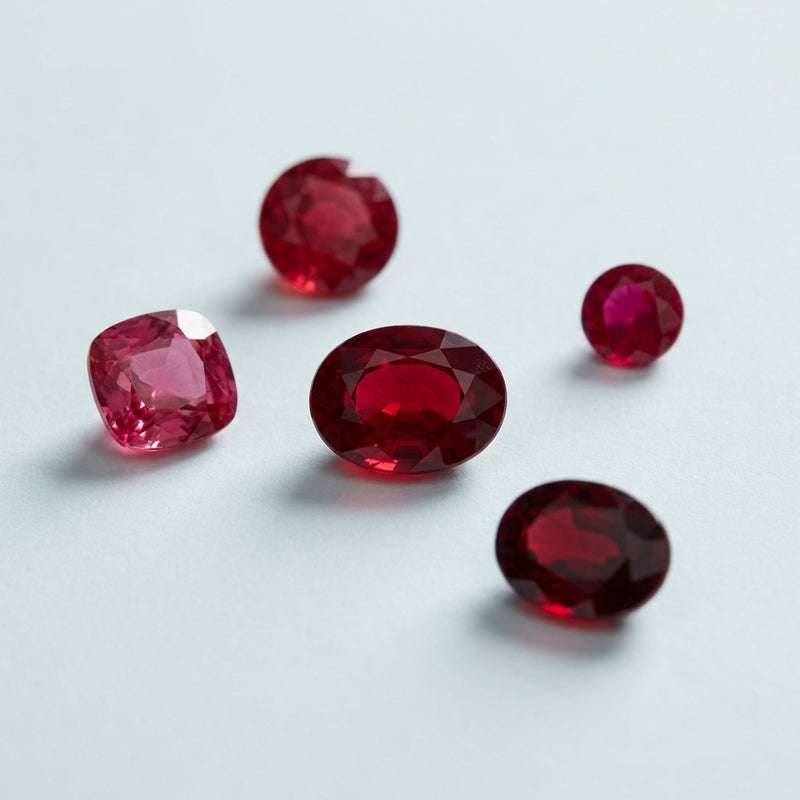
Bold red tones with strong symbolism and standout colour. A meaningful choice for a milestone anniversary gift.
Hardness9 / Mohs
DurabilityExcellent
Colour rangePink to deep red
Rubies are the red variety of corundum, scoring 9 on the Mohs scale. Their colour ranges from pinkish-red to deep pigeon blood red.
Excellent for daily wear. High hardness makes rubies a very practical choice for regular wear.
Clean with warm soapy water and a soft brush. Generally suitable for ultrasonic cleaning — ask your jeweller first.
Best paired with18ct yellow gold or platinum — yellow gold intensifies the red; platinum lets the colour speak alone
Diamond shapes
Explore the ten most popular diamond shapes
Each shape carries a distinct character, proportion, and light behaviour. Select one to explore its profile, settings, and what makes it right for your commission.
Top
Side
Round
Brilliant cut
Top
Side
Oval
Elongated sparkle
Top
Side
Cushion
Soft brilliance
Top
Side
Princess
Step & brilliant
Top
Side
Emerald
Step cut
Top
Side
Pear
Teardrop
Top
Side
Marquise
Navette
Top
Side
Radiant
Crushed ice
Top
Side
Asscher
Square step
Top
Side
Heart
Romantic
Top view
Side profile
Round
Brilliant cut
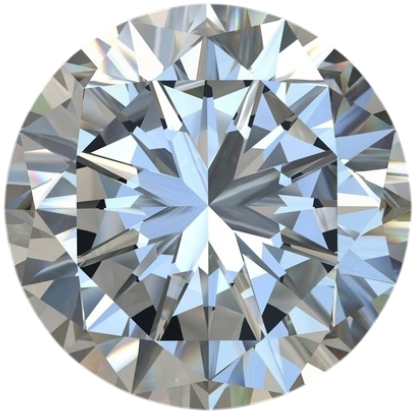
The most popular diamond shape in the world. 58 precisely engineered facets deliver the highest fire and scintillation of any cut — an enduring choice that flatters every setting style and stands the test of time.
CharacterMaximum brilliance and fire
L / W ratio1.00–1.05
SettingsAll settings — especially solitaire · pavé · halo
An oval combines the brilliance of a round with an elongated silhouette that flatters the finger and creates the illusion of greater size per carat. Well suited to solitaire and pavé settings with delicate prong placement.
The cushion blends a rounded square or rectangular outline with large facets that produce a softer, pillow-like sparkle. Its romantic proportions pair beautifully with halo or side-stone designs and vintage-inspired settings.
The princess features a square brilliant cut with sharp, uncut corners. Ranking second in popularity globally, it delivers excellent brilliance with a modern geometric look, suiting contemporary east-west settings particularly well.
The emerald cut uses a rectangular step-cut pattern that emphasises clarity and creates a dramatic hall-of-mirrors effect. It rewards high clarity grades and pairs best with minimal, architectural settings.
The pear combines the round's brilliance with a pointed tip and rounded base. Worn point toward the fingertip, it elongates the hand and suits east-west settings, drops, and solitaires with a protective V-prong.
The marquise is an elongated oval with pointed ends, historically associated with royalty. Its silhouette maximises perceived size per carat and elongates the finger — best set with protective prongs at each tip.
The radiant blends the rectangular outline of an emerald cut with a brilliant faceting pattern, producing a lively, crushed-ice sparkle. It suits a wide range of settings and is an excellent choice for coloured diamonds.
The Asscher is a square step-cut with clipped corners giving an octagonal outline. Concentric rectangular facets create a distinctive windmill pattern when viewed from above. High clarity and precise cutting are essential.
The heart is the most overtly romantic diamond shape, demanding skilled cutting to achieve symmetrical lobes and a clean cleft. Simple bezel or prong settings that display the full silhouette work best.
The most popular diamond shape in the world. 58 precisely engineered facets deliver the highest fire and scintillation of any cut — an enduring choice that flatters every setting style and stands the test of time.
CharacterMaximum brilliance and fire
L / W ratio1.00–1.05
SettingsAll settings — especially solitaire · pavé · halo
An oval combines the brilliance of a round with an elongated silhouette that flatters the finger and creates the illusion of greater size per carat. Well suited to solitaire and pavé settings with delicate prong placement.
The cushion blends a rounded square or rectangular outline with large facets that produce a softer, pillow-like sparkle. Its romantic proportions pair beautifully with halo or side-stone designs and vintage-inspired settings.
The princess features a square brilliant cut with sharp, uncut corners. Ranking second in popularity globally, it delivers excellent brilliance with a modern geometric look, suiting contemporary east-west settings particularly well.
The emerald cut uses a rectangular step-cut pattern that emphasises clarity and creates a dramatic hall-of-mirrors effect. It rewards high clarity grades and pairs best with minimal, architectural settings.
The pear combines the round's brilliance with a pointed tip and rounded base. Worn point toward the fingertip, it elongates the hand and suits east-west settings, drops, and solitaires with a protective V-prong.
The marquise is an elongated oval with pointed ends, historically associated with royalty. Its silhouette maximises perceived size per carat and elongates the finger — best set with protective prongs at each tip.
The radiant blends the rectangular outline of an emerald cut with a brilliant faceting pattern, producing a lively, crushed-ice sparkle. It suits a wide range of settings and is an excellent choice for coloured diamonds.
The Asscher is a square step-cut with clipped corners giving an octagonal outline. Concentric rectangular facets create a distinctive windmill pattern when viewed from above. High clarity and precise cutting are essential.
The heart is the most overtly romantic diamond shape, demanding skilled cutting to achieve symmetrical lobes and a clean cleft. Simple bezel or prong settings that display the full silhouette work best.
Select up to three metals to compare them side by side. Each entry covers karat options, durability, maintenance, and suitability to help you make the right choice for your commission.
Select up to three metals to compare
Deselect a metal to choose another.
Yellow Gold
Overview
The warmest and most timeless choice in fine jewellery. Yellow gold's rich hue is entirely natural and requires no plating or surface treatment. Its colour deepens with higher karat purity, and it remains the most popular metal for bespoke engagement rings and wedding bands worldwide.
Karat options
9K 37537.5% gold. The most durable and affordable option. A lighter, subtler yellow tone. The most widely hallmarked gold in the UK.
14K 58558.3% gold. An excellent balance of richness and resilience. Popular in the US and increasingly chosen in the UK for everyday rings.
18K 75075% gold. The most popular choice for fine jewellery. A deep, warm tone with excellent durability. Our most recommended option.
22K 91691.7% gold. Closest to pure gold in colour. Very soft — best reserved for plain bands without stone settings.
No plating required. Clean periodically with warm soapy water. Higher karats may show surface marks more readily but are easily repolished.
Hypoallergenic
Generally well tolerated. Nickel-free alloys available on request at any karat.
18K yellow gold is our most recommended starting point for bespoke commissions.
White Gold
Overview
White gold achieves its colour through alloying yellow gold with white metals such as palladium. In its natural unplated state it carries a slightly warm or grey tone. Most customers choose rhodium plating to achieve the bright mirror-white finish. See the Rhodium-Plated option for the finished appearance most people associate with white gold.
Karat options
9K 37537.5% gold. Hardest and most affordable. Slightly warmer tone in its natural state. Rhodium plating strongly recommended.
14K 58558.3% gold. Durable and cost-effective. Virtually indistinguishable from 18K once rhodium plated.
18K 75075% gold. The most popular choice for white gold engagement rings. Excellent durability and a bright finish once plated.
Durability
9K
14K
18K
Best suited for
Engagement rings, diamond settings, pieces where a cool white tone is preferred over yellow.
Maintenance
Rhodium plating wears gradually and typically needs refreshing every one to three years depending on wear. Replating is a straightforward service we offer.
Hypoallergenic
Palladium alloy versions are nickel-free. Please request this at enquiry stage if you have a known sensitivity.
White gold in its natural state has a warm grey tone. Rhodium plating is what gives it the bright white finish most customers expect.
Rhodium-Plated White Gold
Overview
Rhodium is a rare platinum-group metal with an exceptionally bright, reflective surface. Applied as a thin electrolytic layer over white gold, it creates the brilliant mirror-white finish most people associate with white gold jewellery. We apply rhodium plating as standard to all white gold pieces and offer a professional replating aftercare service.
Base metal options
9K base 375Most durable base. Most affordable. Plating may need refreshing slightly more often due to the harder alloy surface.
14K base 585Excellent balance of durability and purity. Visually identical to 18K once plated. A popular practical choice.
18K base 750Our most recommended base for rhodium-plated pieces. Highest purity with excellent long-term wearability.
Appearance
Brightness
Reflectivity
Best suited for
Any white gold piece where a bright mirror-white finish is desired. Particularly effective for diamond settings where maximum light reflection matters.
Maintenance
The plating layer wears gradually with daily contact. Most pieces need replating every one to three years. We offer a professional replating service — contact us for current pricing and turnaround times.
Hypoallergenic
Rhodium itself is naturally hypoallergenic and acts as a barrier between skin and the alloys beneath, making this an excellent choice for those with metal sensitivities.
The most reflective finish available in white metal jewellery. The standard choice for diamond engagement rings at À Vie Diamonds.
Rose Gold
Overview
Rose gold achieves its distinctive blush tone through a copper-rich alloy. It is one of the most romantic and fashionable choices in contemporary fine jewellery, pairing beautifully with both white and champagne-toned diamonds. The warm pink hue is inherent to the alloy and requires no plating — it will never fade or need refreshing.
Karat options
9K 375Highest copper content, giving the deepest and most vivid blush. Most durable and affordable.
14K 585Slightly deeper blush than 18K. More resistant to everyday wear. An excellent balance of colour and practicality.
18K 750The most popular choice. A delicate, refined blush tone. Our most recommended option for rose gold engagement rings.
No plating required. The colour is permanent and will not fade. Clean with warm soapy water as needed. Higher copper content may show minor tarnish over time — easily resolved with a light polish.
Hypoallergenic
Contains copper. Those with a known copper sensitivity should discuss alternative alloy options with us before placing an order.
No plating. No fading. The blush colour is inherent to the alloy and is as permanent as the metal itself.
Sterling Silver
Overview
Sterling silver is a bright, accessible metal with a long and distinguished history in fine jewellery. It is softer than gold or platinum and will tarnish without regular wear and care. It remains a beautiful and affordable option for pendants, earrings, and occasional-wear pieces.
Grade
925 Sterling92.5% pure silver. The only grade we work with. Hallmarked 925. The international standard for fine silver jewellery.
Durability
925
Best suited for
Pendants, earrings, bracelets, and occasional-wear rings. Less recommended for daily-wear rings due to softness and tarnishing.
Maintenance
Polish regularly with a silver cloth to maintain shine. Store in an airtight pouch when not worn to slow the natural tarnishing process.
Hypoallergenic
Generally well tolerated. The 7.5% copper alloy content may cause sensitivity in rare cases. Advise us of any known sensitivities at enquiry stage.
For rings intended for daily wear we recommend discussing gold or platinum options during your consultation for longer-lasting results.
Platinum
Overview
Platinum is the most prestigious metal in fine jewellery. Heavier, rarer, and more durable than gold, it develops a natural satin patina over time rather than wearing away. Unlike white gold, platinum requires no rhodium plating as its white colour is entirely natural and permanent. It is the definitive choice for a lifelong commission.
Grade
950 Platinum95% pure platinum. The finest grade used in jewellery. Hallmarked 950. Denser and heavier than gold of equivalent volume, contributing to its premium feel.
Durability
950
Best suited for
Engagement rings, heirloom pieces, those wanting the finest and most durable option available. Particularly well suited to securing high-value diamonds.
Maintenance
Develops a desirable satin patina with wear. Metal displaced by surface contact remains within the piece rather than being lost. Can be repolished to a high shine at any time.
Hypoallergenic
Naturally hypoallergenic. The safest and most suitable choice for those with any metal sensitivity.
The only metal we offer that requires no surface treatment of any kind. Its white colour, weight, and durability are entirely natural.
Select at least one metal above to begin comparing.
Still unsure which metal is right for your piece? Our team is happy to guide you through the options during a complimentary consultation.
Every feature below can be added or discussed at the design stage. Availability varies by setting style.
Key options
Most requested features
Show the core add-ons first so the page feels lighter and easier to scan.
Hidden halo
A full hidden halo is not possible with a full bezel — the rim prevents it. A partial hidd…
A full hidden halo is not possible with a full bezel — the rim prevents it. A partial hidden halo beneath the visible face is achievable on a partial bezel.
Hidden gemstone
A small stone set inside the shank or beneath the setting head. Compatible with all three …
A small stone set inside the shank or beneath the setting head. Compatible with all three bezel variants on plain and wide bands.
Pavé shoulders
Compatible with a partial bezel. On a full bezel, the rim and pavé can visually compete — …
Compatible with a partial bezel. On a full bezel, the rim and pavé can visually compete — discuss at the design stage.
Milgrain detail
Works well on all variants. Particularly effective along the inside edge of the bezel rim …
Works well on all variants. Particularly effective along the inside edge of the bezel rim itself.
East-west orientation
Setting the stone horizontally is most effective on oval, marquise, and pear shapes. Discu…
Setting the stone horizontally is most effective on oval, marquise, and pear shapes. Discuss at the design consultation.
Side stones
Trilliant or tapered baguettes flanking the centre stone for added drama and spread. Discu…
Trilliant or tapered baguettes flanking the centre stone for added drama and spread. Discuss stone size and shape at consultation.
Hidden halo
A full hidden halo is not possible with a full bezel — the rim prevents it. A partial hidd…
A full hidden halo is not possible with a full bezel — the rim prevents it. A partial hidden halo beneath the visible face is achievable on a partial bezel.
Hidden gemstone
A small stone set inside the shank or beneath the setting head. Compatible with all three …
A small stone set inside the shank or beneath the setting head. Compatible with all three bezel variants on plain and wide bands.
Pavé shoulders
Compatible with a partial bezel. On a full bezel, the rim and pavé can visually compete — …
Compatible with a partial bezel. On a full bezel, the rim and pavé can visually compete — discuss at the design stage.
Milgrain detail
Works well on all variants. Particularly effective along the inside edge of the bezel rim …
Works well on all variants. Particularly effective along the inside edge of the bezel rim itself.
East-west orientation
Setting the stone horizontally is most effective on oval, marquise, and pear shapes. Discu…
Setting the stone horizontally is most effective on oval, marquise, and pear shapes. Discuss at the design consultation.
Side stones
Trilliant or tapered baguettes flanking the centre stone for added drama and spread. Discu…
Trilliant or tapered baguettes flanking the centre stone for added drama and spread. Discuss stone size and shape at consultation.
More features
Less common or more specialised additions can sit behind a compact dropdown.
Stones set into the band
Pavé, channel-set, or scattered diamonds along the shank for continuous sparkle. Available…
Pavé, channel-set, or scattered diamonds along the shank for continuous sparkle. Available on all band widths above 2mm.
Knife-edge band
A raised, angular centre ridge gives a slim, light-reflecting profile. Works particularly …
A raised, angular centre ridge gives a slim, light-reflecting profile. Works particularly well on lower-set stones.
Textured finish
Hammered, brushed, matte, or satin finishes on the band or setting. Adds tactile character…
Hammered, brushed, matte, or satin finishes on the band or setting. Adds tactile character to an otherwise minimal design.
Gallery details
Openwork, filigree, or etched designs beneath the stone. Adds light, air, and character to…
Openwork, filigree, or etched designs beneath the stone. Adds light, air, and character to the underside of the setting.
Internal engraving
Dates, initials, patterns, or personal messages engraved inside the band. A detail that’s …
Dates, initials, patterns, or personal messages engraved inside the band. A detail that’s entirely private to the wearer.
Coloured gemstones
Birthstones, sapphires, or rubies as accent stones in halos, shoulder settings, or hidden …
Birthstones, sapphires, or rubies as accent stones in halos, shoulder settings, or hidden spots. Discuss at consultation.
Mixed metals
Contrasting shank and setting head metals — for example, rose gold band with platinum beze…
Contrasting shank and setting head metals — for example, rose gold band with platinum bezel. Discuss viability at the design stage.
Split shank band
The continuous rim of a full or partial bezel conflicts geometrically with a split shank. …
The continuous rim of a full or partial bezel conflicts geometrically with a split shank. Not recommended.
Stones set into the band
Pavé, channel-set, or scattered diamonds along the shank for continuous sparkle. Available…
Pavé, channel-set, or scattered diamonds along the shank for continuous sparkle. Available on all band widths above 2mm.
Knife-edge band
A raised, angular centre ridge gives a slim, light-reflecting profile. Works particularly …
A raised, angular centre ridge gives a slim, light-reflecting profile. Works particularly well on lower-set stones.
Textured finish
Hammered, brushed, matte, or satin finishes on the band or setting. Adds tactile character…
Hammered, brushed, matte, or satin finishes on the band or setting. Adds tactile character to an otherwise minimal design.
Gallery details
Openwork, filigree, or etched designs beneath the stone. Adds light, air, and character to…
Openwork, filigree, or etched designs beneath the stone. Adds light, air, and character to the underside of the setting.
Internal engraving
Dates, initials, patterns, or personal messages engraved inside the band. A detail that’s …
Dates, initials, patterns, or personal messages engraved inside the band. A detail that’s entirely private to the wearer.
Coloured gemstones
Birthstones, sapphires, or rubies as accent stones in halos, shoulder settings, or hidden …
Birthstones, sapphires, or rubies as accent stones in halos, shoulder settings, or hidden spots. Discuss at consultation.
Mixed metals
Contrasting shank and setting head metals — for example, rose gold band with platinum beze…
Contrasting shank and setting head metals — for example, rose gold band with platinum bezel. Discuss viability at the design stage.
Split shank band
The continuous rim of a full or partial bezel conflicts geometrically with a split shank. …
The continuous rim of a full or partial bezel conflicts geometrically with a split shank. Not recommended.
Diamond Carat Size
How carat affects size
Carat is a measure of weight, not size. Move the slider to see how diameter changes with each carat weight.
Millimetre reference
Carat weight0.10 ct — 3.0 mm
Carat weight
0.10ct
Diameter
3.0mm
Approximately the size of a small grain of sand. Delicate and minimal — suited to fine stacking bands rather than solitaires.
Common sizes at a glance
Diameter values based on industry-standard round brilliant proportions. Visual scale is proportionally accurate, not physically absolute.
Diamond properties
Explore the four Cs
Adjust each slider to see how cut, colour, and clarity affect the appearance and value of a diamond.
Adjust the sliders to explore the four Cs
CutExcellent
ColourD
ClarityFL
Excellent
ExcellentV.GoodGoodFairPoor
Maximum brilliance. Every facet aligned to return the most light possible.
D
DEFGHJMZ
Completely colourless. The rarest and most sought-after grade.
FL
FLIFVVS1VVS2VS1VS2SI1SI2I1I2I3
Flawless. No inclusions or blemishes visible under 10× magnification.
Ready to discuss your diamond? Our team can guide you through stone selection that matches your priorities.
Complimentary · No obligation · Remote Consultations
Our commitment to you
Designed with clarity from start to finish
You approve the design, the stone and the price before anything is made. The process is built to keep the important decisions visible from the start.
Direct communication at every stage
You work directly with our team throughout. No account managers, no handoffs. Clear updates at every step of the process.
No intermediaries
Nothing is made until you approve the design
We present the full design, stone selection, and pricing before a single piece of metal is worked. Your sign-off comes first.
Full approval control
Design refinements agreed before production
Proportions, settings, and structural details are refined and confirmed with you before we proceed. No assumptions are made.
Confirmed before production
Pricing agreed before production begins
The full cost is confirmed and agreed before any work starts. There are no surprises at the end of the process.
Transparent pricing
Every piece inspected before dispatch
Each piece is checked for finish quality, stone alignment, and setting security before it leaves us. We do not dispatch work we would not wear ourselves.
Quality assured
Client proof
Recent clients mention the same things: clarity, service and no pressure.
"Smooth, effortless and genuinely educational from start to finish."
James Wood · Bespoke engagement ring
"Great experience, pain free. Created exactly what I asked for."
Oliver · Bespoke commission
How they compare
Comparison Gemstones
Every stone has a character.
EmeraldColour and character
SapphireClassic and durable
RubyRare and vivid
DiamondBrilliance and hardness
Colour character
Warm, vivid green — unique among gemstones
Rich blue to blue-green range
Pure red — the rarest vivid colour
Colourless — brilliance over colour
Durability
7.5–8 Mohs, prone to chipping
9 Mohs, excellent for daily wear
9 Mohs, very durable
10 Mohs, hardest natural material
Rarity
Fine colour is genuinely scarce
Good quality readily available
Fine unheated rubies extremely rare
Abundant at commercial grades
Treatment
Oiling is universal and accepted
Heat treatment is standard
Heat and fracture filling common
Most are natural, some laser-drilled
Value retention
Strong for certified fine stones
Consistent long-term demand
Finest examples appreciate strongly
Commodity grades less reliable
Care required
No ultrasonics, gentle cleaning only
Low maintenance, easy to clean
Low maintenance, very robust
Minimal care needed
Price per carat
Premium for fine colour and low oil
Fine Kashmir or Burma commands premium
Highest per-carat of the three
Wide range by cut and certification
Character
Jardin inclusions add individuality
Clean, consistent appearance
Silk inclusions can confirm origin
Standardised grading, less unique
Commissioning questions
What to know before starting your ring
Clear answers on remote commissioning, timing, budget, certification and how the Ring Match service works.
Yes. À Vie Diamonds is based in Manchester and works with clients across the UK by phone, video call, WhatsApp and email. The process can be handled remotely from first brief through stone approval, CAD design sign-off, production, hallmarking and insured delivery.
Most bespoke engagement rings are completed within approximately 8-12 weeks, depending on the design, stone sourcing, revisions and production requirements. The manufacturing stage may be shorter once the final design, stone and price have been approved. If you have a proposal date or travel deadline, include it in your first enquiry so we can advise honestly.
The final cost depends mainly on the centre stone, metal, setting complexity and any additional stones. À Vie designs around the agreed budget and confirms the stone, design and price before production begins. The engagement ring pricing guide explains the main cost drivers.
Yes. The Ring Match service lets you send a link, screenshot or photo of a ring you have seen elsewhere. À Vie can propose a matched specification or suggest improvements such as a better centre stone, upgraded metal or adjusted setting for a similar budget.
Where certification is relevant, À Vie works with independently graded GIA or IGI diamonds and explains the certificate details before production. The aim is that you understand exactly what is being supplied before you approve the final ring.
No. Manchester is the studio base, but the service is UK-wide. Many clients commission remotely, with the same design approval process, stone guidance, hallmarking checks and insured delivery.
Tell us the ring style, stone preference, budget and timing you have in mind. We will advise on what is realistic before anything is made.