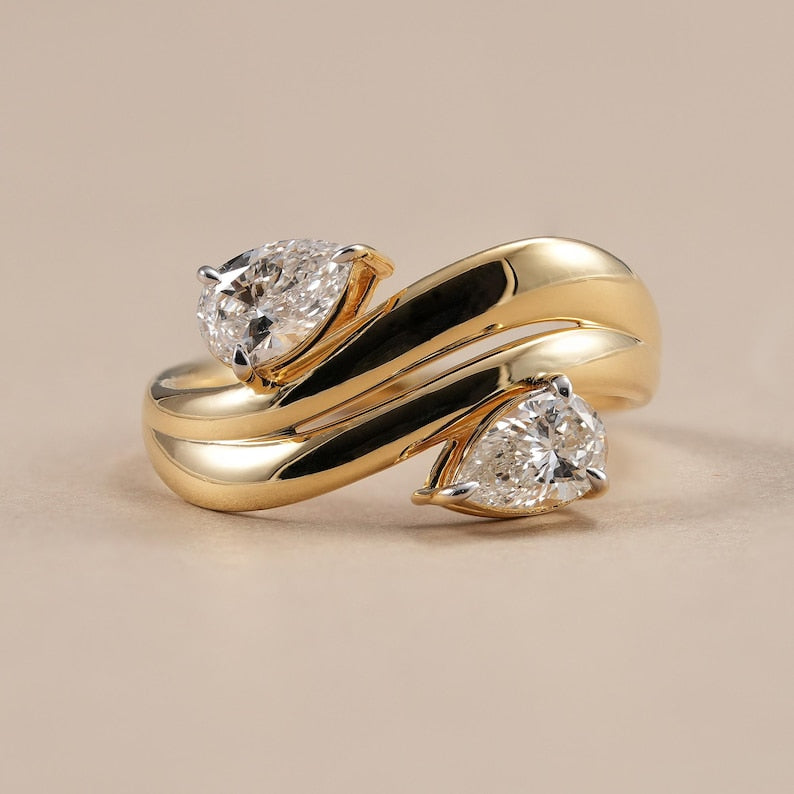
ring setting

Toi et moi engagement rings: two stones, one ring, deeply personal

A bespoke toi et moi engagement ring places two stones side by side, giving you more freedom over shape, colour, symbolism and how the two stones relate.

RING SETTINGS EXPLAINED

The toi et moi setting

Everything you need to know about the toi et moi before making a decision.

THE BASICS

What is a toi et moi ring?

Two stones. Side by side. Neither dominant over the other.

A toi et moi ring features two stones set side by side on a shared band, with no single stone taking the role of centre stone. The name comes from the French for “you and me”, and the design has traditionally carried a symbolic resonance that the solitaire simply cannot offer. The two stones represent two people — equal in presence, equal in value.

The stones can be identical — two ovals, two rounds, two pear shapes — or complementary contrasting shapes. Oval and pear is the most popular pairing. Emerald and round is clean and architectural. Round and pear has a softer, more romantic balance. The two stones can also be different stone types: a diamond paired with a sapphire, an emerald, or a fancy colour diamond is entirely within the bespoke remit.

The toi et moi is one of the oldest engagement ring forms. Napoleon proposed to Joséphine in 1796 with a two-stone sapphire and diamond ring that remains among the most recognised pieces of jewellery history. After a long period of eclipse by the solitaire, the toi et moi has returned as one of the most talked-about engagement ring styles in the UK.
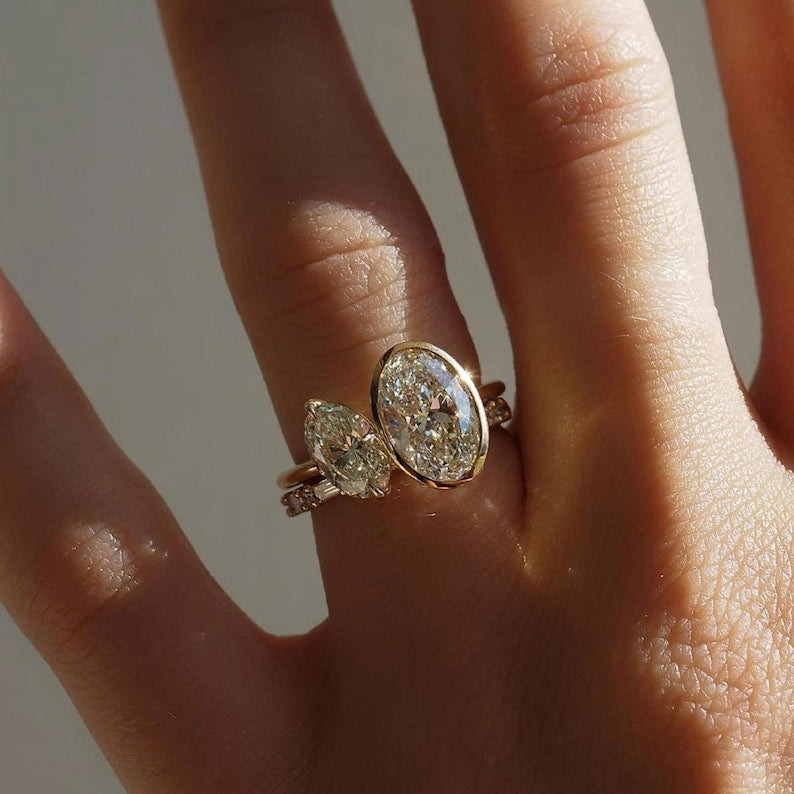
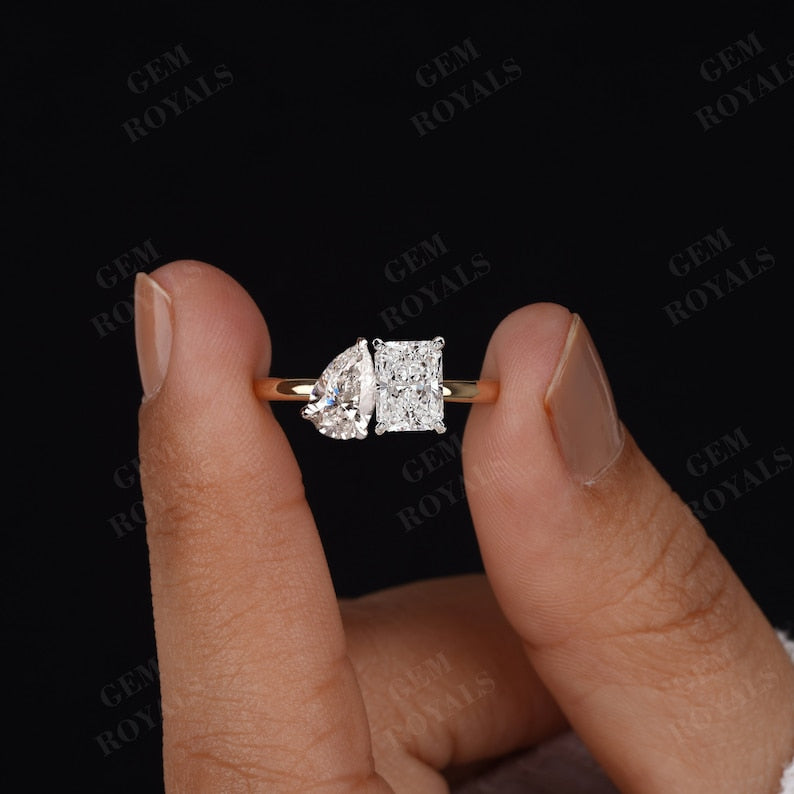
Toi et moi engagement ring with two stones set side by side

IS IT RIGHT FOR YOU?

Who chooses a toi et moi?

The toi et moi is chosen by people who want a ring that feels personal in a way a solitaire cannot quite achieve. The two-stone format opens up combinations — of shape, of stone type, of colour — that simply are not available with a single centre stone. It suits clients who have a clear point of view about jewellery and are not looking for the default choice.

It is also a particularly strong format for buyers who want to incorporate a coloured gemstone alongside a diamond. A sapphire and diamond pairing, or a fancy yellow diamond alongside a white one, carries a quiet sophistication that a diamond-only ring cannot replicate. The equal status of the two stones means neither reads as secondary.

Practically, the toi et moi suits a range of lifestyles depending on the setting mechanism chosen. Two bezel-set stones on a plain band is one of the most wearable ring formats available. Two claw-set stones will require the same periodic attention as any prong setting. We can discuss both approaches at the consultation stage.

Toi et moi ring showing oval and pear stone pairing

STONE COMBINATIONS

Choosing your two stones

The stone combination is the central design decision in a toi et moi. The most common approaches are two stones of the same shape and size for a symmetric, balanced look; two stones of the same shape but slightly different sizes for a subtle asymmetry; or two contrasting shapes for a ring with more visual tension and character.

Oval and pear is the most established pairing — the elongated oval balances the tapered pear in a way that feels both considered and organic. Round and pear is softer. Emerald and round brings together a step-cut and a brilliant cut in a pairing that is architecturally clean. Cushion and round is rounder and more romantic. There is no wrong answer, and the consultation stage is where we work through the options together.

Mixing stone types opens up further possibilities. A diamond and a blue sapphire echoes the original Napoleon and Joséphine ring. A fancy yellow diamond alongside a white one creates warmth without introducing a different stone species entirely. Whatever the combination, we source each stone individually and present the options with full grading certificates before any decision is made.

Toi et moi ring stone combination options

BAND OPTIONS

Band styles for a toi et moi

The band design is where the toi et moi has some of its most distinctive options. A plain band is the cleanest approach and lets the stone pairing do all the work. A twisted band, where the two strands of the shank each approach one stone from opposite directions, reinforces the ‘two becoming one’ symbolism of the design. A bypass band — where each shank wraps around its stone from the opposite side — is the most architecturally complex and interesting option unique to this format. Pavé shoulders add sparkle on the approach to the stones without changing the character of the composition.

If you are unsure which setting and band combination suits your lifestyle or your stone pairing, that is exactly what the consultation is for. Nothing is made until you have approved the final design in full.

Setting mechanism detail on a toi et moi ring

Why toi et moi rewards stone pairing

The value is in how the two stones relate

A toi et moi ring divides the visual weight across two stones rather than one centre stone. That can make the design feel more individual, and it gives you more control over shape, colour and symbolism.

The value depends on pairing. Two stones that are beautiful separately can still feel awkward together if the proportions, heights or setting mechanisms are not resolved at the design stage.

More individuality Two stones allow combinations of shape, colour and meaning that a single-stone ring cannot offer.
More budget flexibility The stone budget can be split between two complementary stones rather than concentrated in one centre diamond.
More design judgement Shape pairing, setting height and band flow need careful control so the ring feels balanced.
Commission remotely

How do they compare?

Setting mechanisms for a toi et moi

Each stone in a toi et moi sits in its own individual setting. The mechanism is chosen per stone based on the shape, the stone pairing, and the overall design direction.

Most common · Open · Versatile

4-Claw Prong

Four prongs per stone hold each diamond at its compass points or ends, keeping the metal minimal and the stone fully visible. The standard choice for a toi et moi — works with nearly every stone shape pairing.

Wearability Medium

Prong tips can snag — annual check recommended for both settings.

Modern · Protective · Architectural

Full Bezel

A continuous metal rim encircles each stone completely. No prongs. The most wearable toi et moi option and the most distinctly contemporary look — particularly strong with two ovals.

Wearability High

Bezel on both stones is one of the most snag-free ring formats available.

Considered · Contrasting · Bespoke

Mixed: Bezel + Claw

One stone in a bezel, the other in claw prongs. Less common and requires careful design justification, but can work beautifully when the stone shapes or types are already contrasting — the mixed mechanism echoes the mixed pairing.

Wearability Medium

The claw-set stone requires the same periodic attention as any prong setting.

Antique · Georgian revival · Specialist

Collet

An open-back collet is a pre-modern setting form where a plain band of metal encircles the stone’s girdle without a closed base. Historically appropriate for the toi et moi — the style originates in the Georgian and Victorian eras when the collet was the dominant setting form.

Wearability Medium

An open-back collet allows more light through the stone but requires a skilled bench jeweller and periodic inspection.

Most common · Open · Versatile

4-Claw Prong

Four prongs per stone hold each diamond at its compass points or ends, keeping the metal minimal and the stone fully visible. The standard choice for a toi et moi — works with nearly every stone shape pairing.

Wearability Medium

Prong tips can snag — annual check recommended for both settings.

Modern · Protective · Architectural

Full Bezel

A continuous metal rim encircles each stone completely. No prongs. The most wearable toi et moi option and the most distinctly contemporary look — particularly strong with two ovals.

Wearability High

Bezel on both stones is one of the most snag-free ring formats available.

Considered · Contrasting · Bespoke

Mixed: Bezel + Claw

One stone in a bezel, the other in claw prongs. Less common and requires careful design justification, but can work beautifully when the stone shapes or types are already contrasting — the mixed mechanism echoes the mixed pairing.

Wearability Medium

The claw-set stone requires the same periodic attention as any prong setting.

Antique · Georgian revival · Specialist

Collet

An open-back collet is a pre-modern setting form where a plain band of metal encircles the stone’s girdle without a closed base. Historically appropriate for the toi et moi — the style originates in the Georgian and Victorian eras when the collet was the dominant setting form.

Wearability Medium

An open-back collet allows more light through the stone but requires a skilled bench jeweller and periodic inspection.

Sparkle

Maximum — stone fully open to light from all directions

Good — the bezel rim limits light entry from the sides; well-cut stones still perform strongly

Variable — the claw-set stone performs fully; the bezel-set stone as above

Good to excellent — the open back of a collet allows more light through the base than a closed bezel

Stone protection

Good — four prongs per stone hold both securely; pointed tip shapes need V-prong protection

Maximum — the continuous metal rim gives the most complete edge protection available

Mixed — the bezel-set stone is fully protected; the claw-set stone carries standard prong risk

Moderate — the open back leaves the base of the stone exposed compared to a closed setting

Wearability

Medium — prongs on two adjacent stones can catch on fabric; annual check recommended

High — smooth continuous rims on both stones, nothing to snag

Medium — the claw-set stone introduces the same snagging considerations as a standard prong ring

Medium — similar to bezel in profile but the open back requires a careful craftsman to execute well

Visual stone size

Maximum — minimal metal means each stone reads at full size

Slightly reduced — the metal rim slightly contains the apparent size of each stone

Variable — the claw-set stone reads at full size; the bezel-set stone slightly smaller

Similar to bezel from above; the open back reads lighter in profile

Stone shape range

All shapes — V-prong essential for pointed tips such as pear and marquise

Best for oval, round, and cushion — bezel requires a custom-formed rim per stone shape

All shape combinations possible — mechanism matched to each stone individually

Best for round and oval — the collet form suits stones without sharp corners

Design character

Classic, open, stone-forward — the default toi et moi look

Modern, minimal, architectural — a strong contemporary statement

Considered, contrasting, intentionally asymmetric — suits mixed-shape and mixed-stone pairings

Antique, artisan, historically grounded — the most period-appropriate choice for a Georgian-inspired design

6-claw on both stones

Conditional — two adjacent 6-claw baskets create a significant volume of metal between the stones, which can look cluttered and visually crowd the centre of the ring. Discuss at design stage.

Not applicable — bezel replaces the claw entirely

Not applicable on the bezel stone; conditional on the claw stone as above

Not applicable

Mixed stone types

Works well — the same mechanism on both stones gives visual cohesion even when shapes or stone types differ

Works particularly well — a bezel rim on a sapphire and a bezel rim on a diamond creates visual harmony despite the colour contrast

Most natural fit — the mixed mechanism can mirror the intentional contrast of the stone pairing

Works well for same-type pairings; less common for mixed stone types

Sparkle

Maximum — stone fully open to light from all directions

Good — the bezel rim limits light entry from the sides; well-cut stones still perform strongly

Variable — the claw-set stone performs fully; the bezel-set stone as above

Good to excellent — the open back of a collet allows more light through the base than a closed bezel

Stone protection

Good — four prongs per stone hold both securely; pointed tip shapes need V-prong protection

Maximum — the continuous metal rim gives the most complete edge protection available

Mixed — the bezel-set stone is fully protected; the claw-set stone carries standard prong risk

Moderate — the open back leaves the base of the stone exposed compared to a closed setting

Wearability

Medium — prongs on two adjacent stones can catch on fabric; annual check recommended

High — smooth continuous rims on both stones, nothing to snag

Medium — the claw-set stone introduces the same snagging considerations as a standard prong ring

Medium — similar to bezel in profile but the open back requires a careful craftsman to execute well

Visual stone size

Maximum — minimal metal means each stone reads at full size

Slightly reduced — the metal rim slightly contains the apparent size of each stone

Variable — the claw-set stone reads at full size; the bezel-set stone slightly smaller

Similar to bezel from above; the open back reads lighter in profile

Stone shape range

All shapes — V-prong essential for pointed tips such as pear and marquise

Best for oval, round, and cushion — bezel requires a custom-formed rim per stone shape

All shape combinations possible — mechanism matched to each stone individually

Best for round and oval — the collet form suits stones without sharp corners

Design character

Classic, open, stone-forward — the default toi et moi look

Modern, minimal, architectural — a strong contemporary statement

Considered, contrasting, intentionally asymmetric — suits mixed-shape and mixed-stone pairings

Antique, artisan, historically grounded — the most period-appropriate choice for a Georgian-inspired design

6-claw on both stones

Conditional — two adjacent 6-claw baskets create a significant volume of metal between the stones, which can look cluttered and visually crowd the centre of the ring. Discuss at design stage.

Not applicable — bezel replaces the claw entirely

Not applicable on the bezel stone; conditional on the claw stone as above

Not applicable

Mixed stone types

Works well — the same mechanism on both stones gives visual cohesion even when shapes or stone types differ

Works particularly well — a bezel rim on a sapphire and a bezel rim on a diamond creates visual harmony despite the colour contrast

Most natural fit — the mixed mechanism can mirror the intentional contrast of the stone pairing

Works well for same-type pairings; less common for mixed stone types

The bottom line

Choose 4-claw if you want maximum sparkle and the most versatile mechanism across all stone shape pairings. The standard toi et moi setting for good reason.

Choose full bezel if wearability is a priority or if you want a clean, modern aesthetic. Particularly strong with two oval stones.

Choose mixed bezel and claw when the stone pairing is already intentionally contrasting — the mixed mechanism can feel like a design decision rather than a compromise.

Choose a collet setting if you want a Georgian or Victorian design direction. Historically the most appropriate mechanism for a toi et moi and a genuine point of difference.

Not sure which mechanism suits your stone shapes and lifestyle? We can talk through the options before any commitment is made.

Talk to us

DESIGN OPTIONS

Additional features

Every feature below can be added or discussed at the design stage. Availability varies by stone combination and setting choice.

Bypass band

Available

Each shank wraps around its stone from the opposite side, creating the most architecturally distinctive band option unique to the toi et moi format.

Twisted band

Available

The two strands of the shank approach each stone from opposite directions, reinforcing the ‘two becoming one’ symbolism of the design.

Pavé shoulders

Available

Small diamonds along the shoulders of the band for added sparkle on the approach to the two stones. Does not change the character of the composition.

Mixed stone types

Available

One diamond paired with a coloured gemstone — sapphire, emerald, or ruby — or a fancy colour diamond alongside a white one. The two-stone format is one of the strongest for mixed pairings.

East-west orientation

Available

One or both stones can be rotated 90 degrees so the long axis runs across the finger. Particularly effective with pear or marquise shapes.

Bezel on both stones

Available

Bezel-setting both stones gives the ring a very clean, modern profile and makes it one of the most wearable two-stone formats available. Particularly strong with two ovals.

Split shank

Available

The band divides as it approaches the stones, adding visual presence and framing each stone individually. Particularly effective when the two stones are set with a small gap between them.

Hidden gemstone

Available

A small stone set inside the shank or beneath one of the settings. A private detail known only to the wearer — birthstone, favourite colour, or a stone with personal significance.

Subtle size asymmetry

Available

The two stones can be subtly different in size — one slightly larger than the other — for a less symmetric, more organic composition.

Internal engraving

Available

Dates, initials, or a private message engraved inside the band. A classic personal detail that sits beneath the two stones.

Mixed metals

Available

For example, a yellow gold band with platinum setting heads. Particularly effective where one stone has warm tones and the other is colourless — each stone can be set in its complementary metal.

Milgrain detail

Partial

Fine milgrain edging on the band or around the settings adds a vintage or artisan quality. Works particularly well on toi et moi rings with a Georgian or Victorian design direction.

Bypass band Available

Each shank wraps around its stone from the opposite side, creating the most architecturally distinctive band option unique to the toi et moi format.

Twisted band Available

The two strands of the shank approach each stone from opposite directions, reinforcing the ‘two becoming one’ symbolism of the design.

Pavé shoulders Available

Small diamonds along the shoulders of the band for added sparkle on the approach to the two stones. Does not change the character of the composition.

Mixed stone types Available

One diamond paired with a coloured gemstone — sapphire, emerald, or ruby — or a fancy colour diamond alongside a white one. The two-stone format is one of the strongest for mixed pairings.

East-west orientation Available

One or both stones can be rotated 90 degrees so the long axis runs across the finger. Particularly effective with pear or marquise shapes.

Bezel on both stones Available

Bezel-setting both stones gives the ring a very clean, modern profile and makes it one of the most wearable two-stone formats available. Particularly strong with two ovals.

Split shank Available

The band divides as it approaches the stones, adding visual presence and framing each stone individually. Particularly effective when the two stones are set with a small gap between them.

Hidden gemstone Available

A small stone set inside the shank or beneath one of the settings. A private detail known only to the wearer — birthstone, favourite colour, or a stone with personal significance.

Subtle size asymmetry Available

The two stones can be subtly different in size — one slightly larger than the other — for a less symmetric, more organic composition.

Internal engraving Available

Dates, initials, or a private message engraved inside the band. A classic personal detail that sits beneath the two stones.

Mixed metals Available

For example, a yellow gold band with platinum setting heads. Particularly effective where one stone has warm tones and the other is colourless — each stone can be set in its complementary metal.

Milgrain detail Partial

Fine milgrain edging on the band or around the settings adds a vintage or artisan quality. Works particularly well on toi et moi rings with a Georgian or Victorian design direction.

What to budget

A toi et moi engagement ring from £1,500 — designed around your brief

A toi et moi uses two stones in place of one, which affects how the stone budget is divided. Here is what to expect at each level.

Essential

From £1,500

Two smaller lab-grown stones of matching or complementary shapes on a plain band. The most accessible toi et moi commission — two stones, clean setting, no additional detail.

Plain bandTwo lab-grown stones

Statement

£6,000 and above

Two larger stones above 0.8ct each, a mixed diamond and coloured gemstone pairing, or a more complex bespoke band design — bypass construction, hand-finished detail, or a mix of metals and stone types.

Above 0.8ct per stoneMixed stone pairingFull bespoke

Everything you need to know

Frequently asked questions about the toi et moi

A toi et moi ring has two stones set side by side, neither dominant over the other. The name means “you and me” in French. It is an alternative to the traditional solitaire for buyers who want something individual, and one of the most talked-about engagement ring styles in the UK.
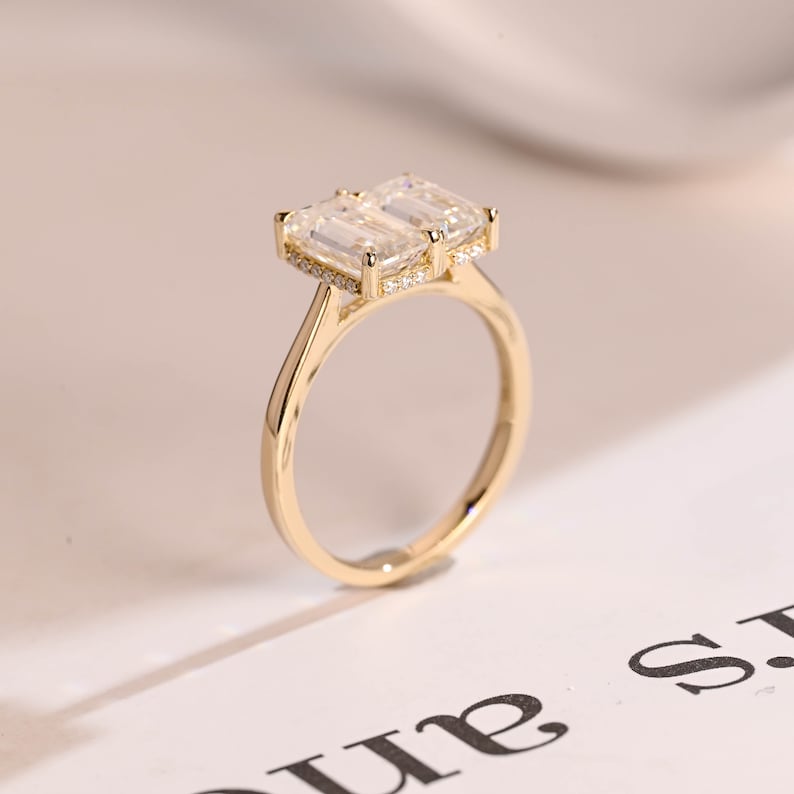
Almost any two shapes can be paired, but some combinations are more established than others. Oval and pear is the most popular pairing. Two ovals is equally common. Emerald and round, round and pear, and cushion and round are all strong combinations. We always present stone options at the consultation stage.

Yes. A toi et moi ring is one of the formats where mixing a diamond and a coloured gemstone, or two coloured gemstones, works naturally. The two-stone structure gives each stone equal visual weight, so a diamond and sapphire pairing carries a quiet balance that a coloured stone solitaire cannot quite replicate.

A trilogy has three stones — a centre stone flanked by two smaller stones, typically carrying a past, present, and future symbolism. A toi et moi has two equal stones with no hierarchy between them. A trilogy always has a dominant centre stone; a toi et moi does not.

The revival is recent, but the style is very old. Georgian and Victorian era rings frequently used two-stone settings, and Napoleon proposed to Joséphine in 1796 with a toi et moi ring. The modern revival is driven partly by high-profile proposals and partly by buyers wanting a genuine alternative to the solitaire.

Four-claw prongs are the most common choice and work with almost every stone shape pairing. Full bezel on both stones is the most wearable option and gives a clean, modern result — particularly strong with two ovals. The mechanism can also differ per stone: one bezel-set and one claw-set works when the stone shapes are already intentionally contrasting. A collet setting is a specialist option that suits a Georgian or Victorian design direction.

Two stones of equal or similar size means the stone budget is divided across both. Most toi et moi commissions at À Vie are in the £2,500 to £6,000 range, depending on the size and quality of each stone. Lab-grown stones reduce the stone cost significantly for buyers where budget is a constraint. The ring starts from £1,500 for a simpler design with two smaller lab-grown stones.

Yes. All precious metals work well for a toi et moi. Yellow gold is particularly flattering when one or both stones has warm tones — a yellow or pink diamond, for example. Platinum suits a more contemporary, minimal design direction. Mixed metals — a yellow gold band with platinum setting heads — are also an option and can be used to complement contrasting stone types.

Still have a question? Our team typically responds within one business day.

Ring settings

Engagement ring styles

Choose a setting that suits your lifestyle and design vision. Each style is engineered for security, comfort, and proportion.

15 setting styles

Select a setting style to explore it

Halo

Halo

A frame of diamonds that amplifies sparkle and apparent size

Side Stone

Side Stone

Shoulder stones that add brilliance and visual width

Trilogy

Trilogy

Three stones symbolising past, present, and future

Cluster

Cluster

Multiple diamonds arranged for maximum sparkle and character

Bezel

Bezel

A smooth metal rim that protects and frames the stone

Prong

Prong

Prongs maximise light return with a variety of claw styles

Bar-Set

Bar-Set

Clean lines with diamonds held between upright metal bars

Channel-Set

Channel-Set

Diamonds set flush within a continuous channel in the band

Pave

Pave

A surface of micro-set diamonds delivering continuous sparkle

Bead-Set

Bead-Set

Small beads of metal raised to secure each individual stone

Flush

Flush

Stone sits level with the band surface for a minimal profile

Tension

Tension

The stone appears suspended between two ends of the band

East-West

East-West

Stone set horizontally for a contemporary elongated look

Knife-Edge

Knife-Edge

A crisp ridge runs along the band for a structured profile

Split Shank

Split Shank

The band divides to frame the centre stone with added presence

Bespoke toi et moi engagement rings

Commission your toi et moi engagement ring

Every piece designed around your brief, your stone pairing, and your budget. No showroom. No pressure. Just a considered process from first conversation to finished piece.