Shaped, curved, fitted and flush

Wedding bands for your engagement ring

A wedding band can be straight, shaped, curved, fitted or planned to sit flush beside your engagement ring. We design that fit around the actual ring, not a generic band shape.

RING ARCHITECTURE EXPLAINED

The cathedral setting

A practical guide to cathedral engagement rings, profile height, wedding-band fit and side-profile design.

THE STYLES

Shaped, curved, fitted and flush wedding bands

These words describe how the wedding band meets the engagement ring, not a single stock shape.

A shaped or curved wedding band follows the outline of the engagement ring, so the two sit closer together. A fitted or contoured band is shaped more closely to a particular engagement ring, often from a measurement or a CAD of that ring. A flush fit means the wedding band sits close beside the engagement ring without a visible gap.

Not every engagement ring will accept a straight band. Halos, low baskets, clusters and some side stone settings often need a shaped or fitted band, or a change to the engagement ring profile. See our wedding bands page for the styles we commission, and our flush engagement rings page if you are still choosing the engagement ring profile.

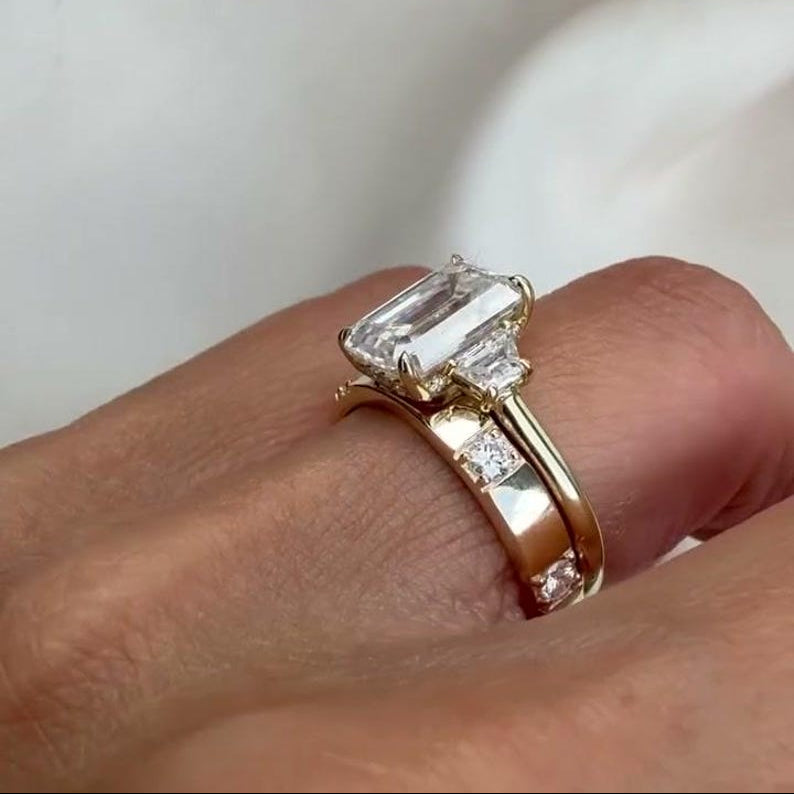
Shaped wedding band made to follow an engagement ring

PLANNING

When to design the two rings together

The safest fit comes from planning the wedding band with the engagement ring, even if the band is made later.

If you already have an engagement ring, we can work from accurate measurements, photographs and, where possible, a mould or CAD of that ring. If you are commissioning both, we can design the engagement ring so a straight band will sit flush, or plan a shaped band from the start.

For more detail on pairing, read Choosing a wedding band to match your engagement ring and Which engagement rings sit well with a wedding band?.

Engagement ring setting with space planned for a wedding band

WHAT TO CONSIDER

Comfort, metal and later changes

Width, profile and metal should be chosen with the engagement ring, not after it.

A fitted band belongs to a particular engagement ring. If that ring is resized later, or replaced, the fitted band may no longer sit as planned. We will say this clearly before making begins. Comfort fit insides, band width and metal hardness also change how the two rings wear together.

Read Contoured and notched wedding bands and What is a flush fit wedding band? for the practical differences.

Three plain wedding bands in yellow gold, white metal and rose gold

Why plan both rings

The wedding band should be designed around the engagement ring you actually have

Off the shelf bands are cut for a generic outline. A bespoke band can follow the real head, basket and shoulder of your engagement ring, or we can design that engagement ring so a straight band will sit flush. Pieces start from £600.

Straight band, when the profile allows it A raised, narrow setting often leaves room for a straight wedding band to sit close beside the engagement ring.
Shaped or curved, when the outline gets in the way A curve, notch or contour follows a halo, low basket, cluster or side stones so the two rings sit together.
Fitted, when the band must match one ring A fitted band is made to a particular engagement ring. It gives the closest sit, and belongs to that ring.
See wedding band styles

Compare the approaches

Straight, shaped, curved or fitted?

The right wedding band depends on the engagement ring profile, and on whether you want a straight band or a closer sit.

Plain sit · Where the profile allows it

Straight band

A straight wedding band sits beside a setting that already has enough clearance, often a raised, narrow solitaire.

Wearability High

The simplest band, when the engagement ring leaves room.

Follows the outline

Shaped or curved

The band is gently shaped or curved to follow the engagement ring, closing a gap without being cut to one unique outline.

Wearability High

A flexible choice for many halo, low and side stone profiles.

Made for one ring

Fitted or notched

The band is fitted or notched to a particular engagement ring, often from measurements or a CAD of that ring.

Wearability Medium

The closest sit, but the band belongs to that engagement ring.

Both rings designed together

Flush planned as a set

The engagement ring and wedding band are designed as a pair, so a straight or lightly shaped band can sit flush.

Wearability High

Best when you can plan both rings, even if the band is made later.

Typical use

Raised, narrow settings

Halos, low baskets, side stones

A known engagement ring

A new pair designed together

How close they sit

Flush when clearance exists

Closer than a straight band

The closest sit

Planned to sit flush

If the engagement ring changes

The band still works

Usually still works

May no longer fit

Both rings can be planned again

Making

Simplest to make

Shaped to the outline

Needs accurate measurements or CAD

Best started at the design stage

Best suited to

Classic solitaires with clearance

Many existing engagement rings

An unusual or low outline

Couples designing both rings

Watch outs

A gap means the profile is in the way

The curve must match the real ring

A later resize can change the fit

The band can still be made later

The bottom line

Choose classic cathedral if you want elegant structure and more presence without making the ring highly ornate.

Choose low cathedral if you like the shape of cathedral shoulders but still want the ring to feel practical and relatively low-snag.

Choose high cathedral if straight wedding-band fit and strong centre-stone prominence matter more than keeping the profile low.

Not sure whether cathedral shoulders will help your ring or make it too high? We can check the profile before anything is made.

Talk to us

DESIGN OPTIONS

Choices that affect the sit

We will talk through these before anything is made, so the wedding band and engagement ring work as a pair.

Straight band

Available

Possible when the engagement ring has enough clearance under the head and around the shoulders.

Shaped or curved band

Available

The band follows the engagement ring outline so the two sit closer together.

Fitted or notched band

Available

Made to a particular engagement ring from measurements or a CAD. The closest sit, and specific to that ring.

Flush sit

Partial

A flush sit is a result, not a style on its own. It comes from the engagement ring profile, the band shape, or both.

Comfort fit inside

Available

A comfort fit can change how the band feels and how it sits against a straight or shaped neighbour.

Same metal and finish

Available

Matching metal, width and finish helps the two rings read as a pair. Mixed metals are also possible.

Straight band Available

Possible when the engagement ring has enough clearance under the head and around the shoulders.

Shaped or curved band Available

The band follows the engagement ring outline so the two sit closer together.

Fitted or notched band Available

Made to a particular engagement ring from measurements or a CAD. The closest sit, and specific to that ring.

Flush sit Partial

A flush sit is a result, not a style on its own. It comes from the engagement ring profile, the band shape, or both.

Comfort fit inside Available

A comfort fit can change how the band feels and how it sits against a straight or shaped neighbour.

Same metal and finish Available

Matching metal, width and finish helps the two rings read as a pair. Mixed metals are also possible.

What to budget

A wedding band designed around your engagement ring. Pieces start from £600

Every band is quoted on the brief: metal, width, whether it is plain, diamond set, shaped or fitted, and how it will sit with your engagement ring.

Plain band

Pieces start from £600

A plain wedding band in gold or platinum, including a straight band where the engagement ring already allows a flush sit.

Plain metalStraight or lightly shaped

Diamond set

Pieces start from £600

A diamond set, pavé or eternity style wedding band, planned so it sits with your engagement ring. Quoted on the brief.

Diamond setQuoted on the brief

Shaped, curved, fitted and flush sits explained.

Common questions about wedding bands for an engagement ring

Practical answers on how a wedding band can sit with the engagement ring you have, or the one you are designing.

A shaped wedding band is curved or contoured so it follows the outline of an engagement ring and sits closer beside it than a straight band would.

Curved and contoured describe a band that bends around the engagement ring head or shoulders. You can read more in our article Contoured and notched wedding bands.

A fitted band is made to a particular engagement ring, often from measurements or a CAD of that ring. It can sit very close, and it belongs to that ring. If the engagement ring is resized later, the fitted band may need to be reviewed.

A flush fit means the wedding band sits close beside the engagement ring without a visible gap. It is the result of the engagement ring profile, the band shape, or both. See What is a flush fit wedding band? and our flush engagement rings page.

Yes, if you can. We can design the engagement ring so a straight band will sit flush, or plan a shaped band from the start, even if the band is made later. See our wedding bands page.

Yes. We work from accurate measurements, photographs and, where possible, a mould or CAD of the existing ring. Some outlines are easier than others, and we will say so before making begins.

It can. A fitted band belongs to the engagement ring it was made for. If that ring is resized, the sit may change. We will flag this at the design stage. For resizable designs, we include one free resize within 1 month of delivery, through a local jeweller, with evidence. Full terms are on our aftercare and warranty page.

On our wedding bands page, and in the articles linked from this page, including What wedding band styles can you choose?.

Not sure whether cathedral shoulders suit your stone and wedding band?

Bespoke wedding bands

Commission a wedding band that sits with your engagement ring

Tell us about the engagement ring you have, or the one you are designing, and we will plan the band around it. Pieces start from £600.