

The main parts of a ring in English are the band (also called the shank), the setting that holds the stone, the claws or prongs, and the stone itself. Knowing a few simple words, and sending a photograph or a sketch, is usually enough to describe the ring you want to a jeweller anywhere.
In short: learn the five main words, use photographs to show what you mean, and ask your jeweller to confirm in writing.
The five main words
- Band or shank: the circle of metal that goes around the finger.
- Setting or head: the part on top that holds the stone.
- Claws or prongs: small metal tips that grip the stone. Claws is the usual British word; prongs is American.
- Stone: the diamond or gemstone. The main one is the centre stone.
- Shoulders: the parts of the band on either side of the setting.
More detailed words
- Gallery: the side of the setting under the stone, seen from the side of the ring.
- Basket: a setting with metal joining the claws, like a small cup.
- Bezel: a rim of metal around the whole stone instead of claws.
- Halo: a ring of small stones around the centre stone.
- Pavé: many small stones set close together along the band.
- Hidden halo: small stones set under the centre stone, seen from the side.
You do not need to know every word. Many people use only band, stone and claws, and point to photographs for the rest.
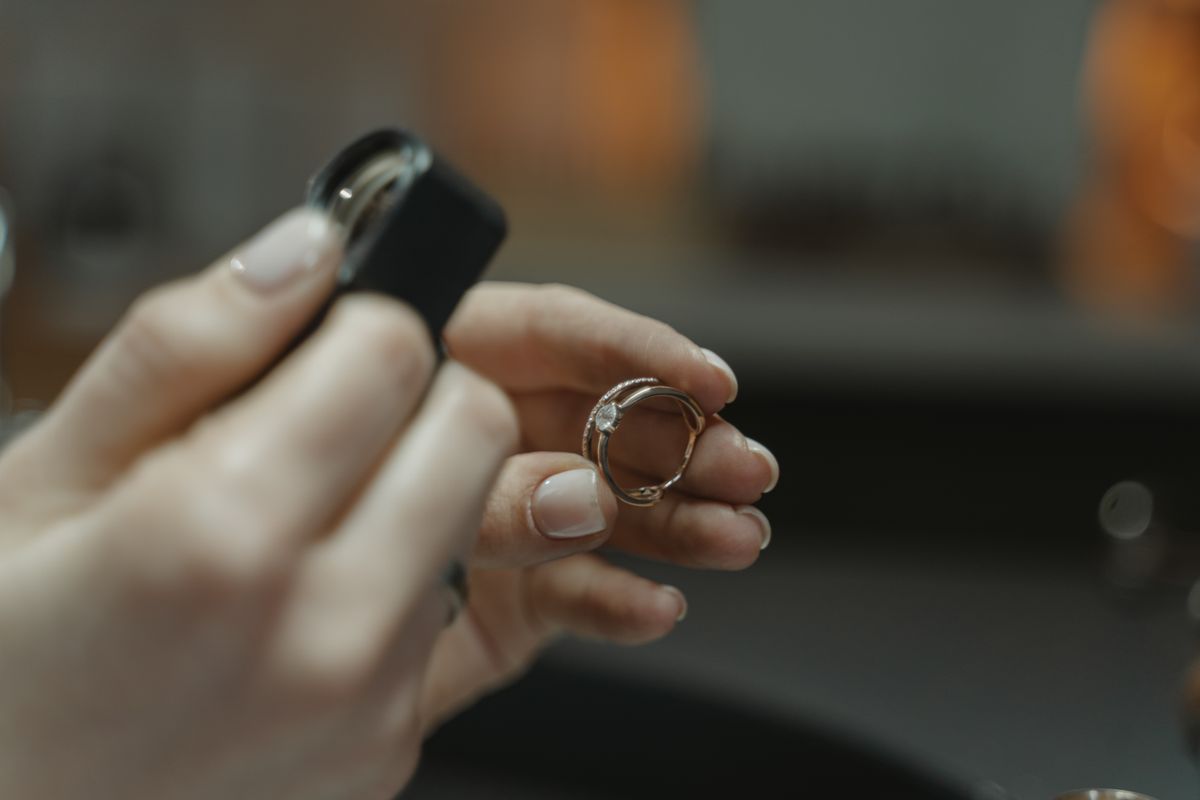
Photo: Tima Miroshnichenko via Pexels.
Using photographs and sketches
A photograph often explains more than words. Save pictures of rings you like and mark the parts you love, such as the band shape or the setting. A simple drawing can help too, even if it is rough. When you send pictures, say what you like about each one, for example, this band, but this setting.
Describing size and shape
For the stone, give the shape, such as round, oval, pear or emerald, and an idea of size in millimetres if you know it. For the band, say whether you want it thin or wide, flat or rounded. For ring size, a millimetre measurement is clearest. Our ring sizing page explains how to measure.
Words for finishes and metals
A polished finish is shiny, and a brushed or satin finish is softly textured. Yellow, white and rose describe the colour of gold. Platinum is a naturally white metal. If you want a band that sits flush against another ring, say fitted or shaped band. Engraving means words or patterns cut into the metal, often inside the band. Comfort fit means the inside of the band is gently rounded, so it feels smooth on the finger.
Useful phrases
Simple phrases help a conversation. Could you send me a drawing? Can you show me the ring from the side? How high does the stone sit? Is this comfortable to wear every day? Your jeweller will be happy to explain anything again, as many times as you need.
Working with a jeweller in English
Ask your jeweller to repeat back what they understood and to send a drawing or a CAD render before anything is made. You can approve the design, ask for changes and check every detail at your own pace. Our page on how to commission your ring remotely explains each step.
If you prefer, write your questions down before a video call, and ask for a written summary afterwards. Clear notes help everyone and avoid surprises.
Frequently asked questions
What is the shank of a ring?
The shank is the band, the circle of metal that goes around the finger.
Are claws and prongs the same?
Yes. Claws is the usual British word, and prongs is the American word.
What if I do not know the right words?
Send photographs and a simple sketch, and ask your jeweller to confirm the design in writing.